Call for sessions: 2016 RGS-IBG Annual International Conference

The call for sessions and papers for the 2016 RGS-IBG Annual International Conference is now open and we would like to invite members to submit session proposals for next year’s conference.


The conference will take place at the Royal Geographical Society in London from the 30th August- 2nd September and will be chaired by Professor Peter Jackson (University of Sheffield). The conference theme is Nexus Thinking. We would particularly encourage sessions around this theme, given the relevance to transport geography.


If you would like to have your session sponsored by TGRG, please submit your session proposal to angela.curl@glasgow.ac.uk AND Sara.Tilley@ed.ac.uk by Friday 18th December. We will confirm session sponsorship by the first week in January and you will then have until Friday 19th February to send out your Call for Papers, choose your presenters and submit your full session proposal to RGS.


Please include the following in your session proposal:

  • A title
  • Names, affiliations and email addresses of the session convenors (we advise TWO)
  • A session abstract (about 200-300 words), and up to five keywords.

(you do not have to use the AC2016 session proposal form at this stage)


Guidance – sessions are scheduled into timeslots of 1 hour 40 minutes long. A session may not normally occupy more than two of these timeslots in the conference programme. TGRG has a ‘ration’ of timeslots, which we will bear in mind when selecting which proposals to sponsor. Please indicate how many high quality papers you think you will attract – four or five (max) ‘traditional’ papers will fit into a timeslot, or you can consider holding a debate, or a workshop, or adopt a different format such as a pecha kucha.


We welcome joint proposals with other groups (who may have a different timeline – please state what that is). For session proposals which attract many high quality submissions, we will consider allowing two timeslots – there are usually 2 or 3 sessions which have two timeslots each.


In addition to promotion of sessions and support in submitting session proposals, one of the benefits of a TGRG sponsored session is that we are given an allocation of guest passes for non geographers and/or non UK conference participants. Session organisers may suggest names of established speakers for whom the TGRG can potentially offer a free conference pass, assuming the criteria for guest passes are met and subject to our allocation of guest passes. We also have a prize for the best paper by a postgraduate researcher presented in any TGRG sponsored session.


The following link may be useful in proposing your session.
http://www.rgs.org/WhatsOn/ConferencesAndSeminars/Annual+International+Conference/Annual+international+conference.htm

Congratulations to Sam Comber, TGRG Undergraduate Dissertation Prize Winner

Congratulations to Sam Comber, from University of Birmingham who has been awarded this year’s prize for the best undergraduate dissertation in Transport Geography, sponsored by Ashgate. The judges were impressed with the advanced statistical approach and overall methodology which went ‘well beyond those normally seen in undergraduate geography dissertations’ and felt that the dissertation overall was ‘extremely high quality’.

Sam’s abstract is below:

This paper evaluates the willingness to pay for rail investments by home-buyers. The investments examined are the Crossrail intervention in Ealing that will improve the Great Western Main Line’s service provisions. As Crossrail is currently incomplete, this paper studies the anticipation effect derived from Crossrail’s mid-2008 announcement. Anticipated benefits of rail investments should factor into home-buyers location choice criteria because of the future transport cost savings. Studying the Crossrail intervention, a three-stage regression approach is introduced to explore the nuances between the estimates of cross-sectional, spatial cross-sectional and quasi-experimental approaches (using difference-in-difference estimators). In doing so, this paper investigates the research hypothesis that Crossrail’s announcement increased housing prices, and that these increases reflected proximity to Crossrail stations. The findings concluded by this paper suggest there are statistically significant premiums for properties located nearer to the sites of planned Crossrail stations following the post-announcement period.

BOOK REVIEW: Sustainable Transportation in the National Parks: From Acadia to Zion, R. Manning, S. Lawson, P. Newman, J. Hallo, C. Monz (Eds.)

David Keeling‘s review of Sustainable Transportation in the National Parks: From Acadia to Zion, edited by: Robert Manning, Steven Lawson, Peter Newman, Jeffrey Hallo and Christopher Monz provides a concise critique of the collection.

Keeling recognises the challenges in bringing together previously published papers into one volume, though these are closely linked to the themes of the book.  The book did have a number of shortcomings from a transport geographer perspective and these are discussed here.

This review is published with the kind permission of Elsevier. It is  also available via Science Direct, published in The Journal of Transport Geography, Vol 48  David Keeling. R. Manning, S. Lawson, P. Newman, J. Hallo, C. Monz (Eds.), Sustainable Transportation in the National Parks: From Acadia to Zion, 2014, University Press of New England, Hanover, ISBN: 978-1-61168-552-7 ($50.00, Paperback) Copyright Elsevier (2015).

BOOK REVIEW: Aluminum Dreams: The Making of Light Modernity, by Mimi Sheller

Weiqiang Lin‘s review of Aluminum Dreams: The Making of Light Modernity, by Mimi Sheller discusses how the author encourages readers to re-examine aluminium, and other vital resources, important to transport geography and a wide range of other disciplines.

Read the full review here.

This review is published with the kind permission of Elsevier. It is  also available via Science Direct, published in The Journal of Transport Geography, Vol 47 Weiqiang Lin, Aluminum Dreams: The Making of Light Modernity, Mimi Sheller. The MIT Press, London (2014). £20.95 (Hardback). ISBN:978-0-262-02682-6

BOOK REVIEW ESSAY: Three books, mostly about seaports

Peter V. Hall provides the Journal of Transport Geography’s second essay-style book review, which is mainly about sea ports.

He reviews:

The review explores four questions:

  1. In rescaling the port, is any particular scale primary, necessary or
    inevitable?
  2. While we know that seaports confer widespread benefits and concentrated costs, what else can we say about their contribution to the uneven geography of contemporary capitalism?
  3. Who are the key agents in making the investment and operational decisions which create these economic geographies?
  4. What are the prospects for environmental sustainability in ports and related transportation-logistic systems?

You can read the full review here.

This review is published with the kind permission of Elsevier. It is also available via Science Direct, published in The Journal of Transport Geography, Vol 47, Peter V Hall, Three books, mostly about seaports: (1) Port-City Interplays in China, James Jixian Wang. Ashgate, Farnham (2014). £60.00 (hardback). ISBN 978-1-4724-2689-5. (2) Institutional Challenges to Intermodal Transport and Logistics, Jason Monios. Ashgate, Farnham (2014). £65.00 (hardback). ISBN 978-1-4724-2321-4. (3) Hub Cities in the Knowledge Economy, Sven Conventz, Ben Derudder, Alain Thierstein, Frank Witlox (Eds.). Ashgate, Farnham (2014). £65.00 (hardback). ISBN 978-1-4094-4591-3.

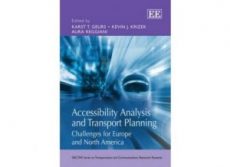
BOOK REVIEW: Accessibility Analysis and Transport Planning: Challenges for Europe and North America by K.T. Geurs, K.J. Krizek, A. Reggiani. Edward Elgar

Angela Curl reviewed Accessibility Analysis and Transport Planning: Challenges for Europe and North America  by Karst Geurs, Kevin Krizek and Aura Reggiani.

Angela states that ‘The book encapsulates the broad spectrum of work which may come under the umbrella of accessibility’ and recommends that readers have a firm grounding in accessibility prior to reading some of more complex chapters. Within the review she emphasises the need for further individual, people-focused efforts to benefit a largely aggregate approach adopted by the sub-discipline.  You can read the review here.

This review is published with the kind permission of Elsevier. It is also available via Science Direct, published in The Journal of Transport Geography, Vol 47, Angela Curl , Accessibility Analysis and Transport Planning: Challenges for Europe and North America (part of the Nectar Series on Transportation and Communications Networks Research), K.T. Geurs, K.J. Krizek, A. Reggiani. Edward Elgar, Cheltenham, UK, Northampton, MA, USA (2012). £80 (hardback). ISBN: 978 1 78100 010 6

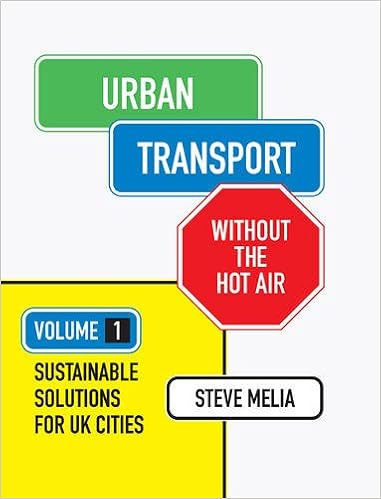
BOOK REVIEW: Urban Transport Without the Hot Air

This is an outstanding book by Steve Melia. I strongly recommend it to anyone in the field, as sumarised in the final paragraph of my review for the Journal of Transport Geography:

Steve Melia has produced a beautiful, meticulously researched and important contribution to the global transport debate. The work synthesises a vast spectrum of evidence on a range of urban transport issues, resulting in a concentrated work of art. Amazingly, this chunk of vital information is also extremely enjoyable to read. I strongly recommend Urban Transport Without the Hot Air to anyone interested in active transport, urban planning or sustainability overall. Indeed, the simple questions of how and why we move around as a species have dramatic (if invisible) implications for the future of human existence on planet Earth. Melia demonstrates that once we properly understand the problems the solutions are within our grasp.

The full review can be seen at the following links.

On the Journal of Transport Geography’s website:

http://www.sciencedirect.com/science/article/pii/S0966692315001532

As a pdf document hosted by the TGRG:

1-s2.0-S0966692315001532-main

Front cover of Melia’s masterpiece

The future of rail travel, and why it doesn’t look like Hyperloop

Senior research associate, Railway Systems Research Group at Newcastle University, explains why at the Conversation:

As the world’s population becomes increasingly urbanised, it is estimated that the number of journeys measured in passenger-kilometres will triple by 2050. Roads simply can’t absorb this increase.

Railways, with their greater capacity for carrying more people, quickly and with greater energy efficiency, are the best bet to become our mobility backbone. Of course, engineers’ imaginations have created many alternatives to the original steel-on-steel approach to the railway. Maglev and the much-publicised but so far theoretical Hyperloop are often regarded as the ones to watch – but do they really represent the future of rail travel?

Read more: http://v.gd/4h0YPO

Mobility: A New Urban Design and Transport Planning Philosophy for a Sustainable Future

This brand new book by John Whitelegg of the Stockholm Environment Institute sets out a rationale for a transformation of the mobility  landscape and argues that the sustainable transport options simply cannot thrive in a world that remains wedded to more mobility and the manifestations of that cultural and political bias (subsidy, infrastructure and an astonishing lack of attention to death, injury, air pollution, climate change and social justice).  See here for more information and await a review in the TGRG.

Continue reading Mobility: A New Urban Design and Transport Planning Philosophy for a Sustainable Future →

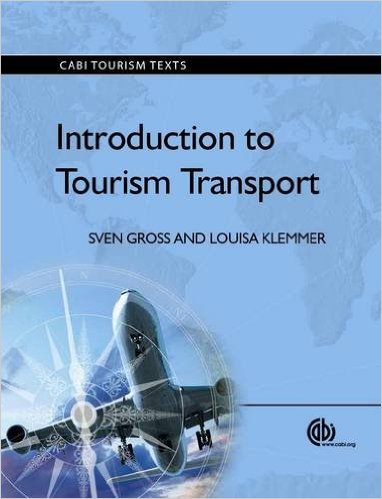
BOOK REVIEW: Introduction to Tourism Transport by Sven Gross and Louisa Klemmer.

Jo Guiver reviewed Introduction to Tourism Transport by Sven Gross and Louise Klemmer.   She recognises the challenges in writing about tourism transport and emphasises the research which allowed for thorough coverage of the breadth of modes available. Her review, available here, concludes that the book provides an excellent reference point but this introduction could be built upon to consider the interrelationships between supply and demand and implications for sustainability.

This review is published with the kind permission of Elsevier. It is also available via Science Direct, published in The Journal of Transport Geography, Vol 46  Jo Guiver, Introduction to Tourism Transport, Sven Gross, Louisa Klemmer.
Cabi Tourism Texts, Wallingford (2014). £37.50, Paperback,
ISBN:978 1 78064 214 7, page 252, Copyright Elsevier (2015).