Category Archives: Prize

2019 Hay award winner

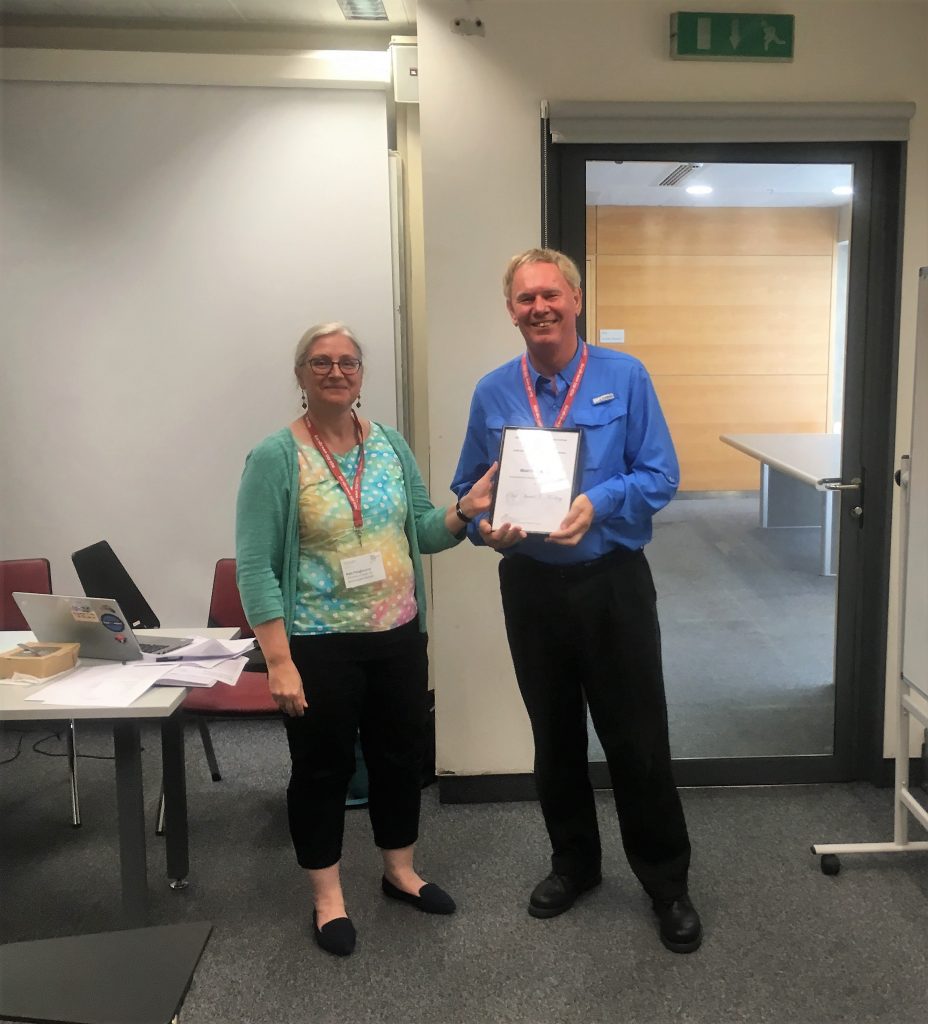
The TGRG are pleased to announce that the 2019 Hay Award for contribution to transport geography has been received by Professor David J Keeling. 

Dr Kate Pangbourne, TGRG Chair, gave the speech below when presenting Professor Keeling with his award:

I am honoured to be able to announce this year’s recipient of the TGRG’s annual Hay Award for contribution to transport geography.

Our nominee this year has had a distinguished academic career despite starting late after following an entirely different career path.

With dozens of publications, including monographs, peer-reviewed articles, encyclopedia entries, editorials, popular articles and book reviews, as well as a considerable amount of documented contribution to student education and service to the discipline in a 40 page CV, we believe we have a worthy recipient, whose work has consistently spanned themes and regions that keep transport geography grounded within the wider family of geography, with an expansive breadth of interest in the world.

The active contribution has included regular engagement with both TGRG and AAG, and editorial board membership and associate editorship of our associated journal, the Journal of Transport Geography.

Long associated with Western Kentucky University, and until very recently University Distinguished Professor of Geography there, I am delighted to invite Professor David J Keeling to receive the Hay Award for 2019.

Congratulations to Professor Keeling!

2017 Undergraduate Dissertation Prize Winner

The TGRG are pleased to announce that the 2017 Undergraduate Dissertation Prize has been won by Philipa Bateman from the School of Geography, University of Nottingham.  The title of her dissertation is Reconnecting the Capital of the Fens: a study of the proposed reopening of the Wisbech-March railway.  Philipa will receive a selection of books to the value of £150 from Edward Elgar Publishing.  We are very pleased to have the continued support from Edward Elgar for this prize.

Reconnecting the Capital of the Fens: a study of the proposed reopening of the Wisbech-March railway

By Philipa Bateman

Abstract

This dissertation provides a critical ex-ante analysis of the proposed reopening of the Wisbech-March rail link in Fenland, Cambridgeshire, which would subsequently link the deprived town of Wisbech to the burgeoning city of Cambridge. An innovative blend of qualitative research methods is used, not only to gain an insight into the local perceptions of the rail link, and the political rationality, upon which the proposal is based, but also to address the scarcity of qualitative research in transport geography, which the literature appeals for.

Generally, this dissertation finds that the rail link would be a positive move for the town, and will help towards combatting income polarisation in Cambridgeshire. However, further considerations must be made, to ensure it will be socially equitable, and not cause further inequality, as it has been identified that this is very possible. In addition to this, the expert local knowledge, uncovered in this dissertation, has challenged several of the proposed economic and environmental benefits, which suggests the current analytical framework for transport infrastructure proposals is somewhat ineffectual. The politics surrounding the rail link, meanwhile, indicate that the social equity impact is not taking precedence in plans. Rather, this is being overlooked in comparison to other concerns, for example enabling Cambridge to prosper further, by providing a mobility fix to its housing shortage.

This dissertation will provide a useful tool for those involved in the planning process, and it contributes to the existing literature on ex-ante analyses. In light of the current standstill,which the proposal finds itself in, due to various reasons, this dissertation will provide some useful information for those involved in the planning process.

Congratulations to David Smith, the 2016 TGRG Undergraduate Dissertation Prize Winner.

We would like to congratulate David Smith for his achievement in winning the TGRGs best undergraduate dissertation prize.  David recently earned his BA in Geography at the University of Oxford.  For the prize, David will receive books to the value of £150 from Edward Elgar.  His dissertation abstract can be found below.  Comments from the judges include: “This ethnographic study of a Welsh heritage railway is detailed and conceptually ambitious. David demonstrates familiarity with concepts in economic and cultural geography, and blends that with mobilities concepts to develop his concept of ‘working mobilities’ in the context of heritage transport. His thesis is also beautifully written, which helped David’s work to stand out above the other ten candidates, all of whom had undertaken interesting and varied work, demonstrating the breadth of interesting topics and approaches that can be used in modern transport geography.”

“Working Mobilities”: Labours, Movements and Moorings at the Ffestiniog and Welsh Highland Railways

This dissertation attends to the different kinds of work that enable mobility to take place. Drawing together ideas from both economic and cultural geography as well as mobilities scholarship, the term ‘working mobilities’ is coined and developed to refer to the labours, practices, performances and personal implications of transport work. Drawing on ethnographic fieldwork undertaken over nine weeks at a heritage railway in Snowdonia during the summer of 2015, the analysis is arranged around three main themes: working, moving and mooring, in order to expand on this hitherto overlooked facet of mobilities.

The first, ‘working’, applies Linda McDowell’s scholarship on ‘body work’ into a heritage railway setting, finding it to be a combination of both old and new forms of labour. Physical work is involved in facilitating mobilities on a literal level – shovelling coal and cleaning floors, for instance. Meanwhile, ‘new’ forms of labour are present too – the body itself becomes a performance through helping to produce particular atmospheres. But skills and knowledges are important too – places are comprehended multi-sensually through combinations of official and tacit knowledges, whilst specific skills are learnt, again directly enabling the smooth operation of mass mobility.

Next, ‘moving’ explores the relationship between those working mobilities and the equipment they use. A series of micro-movements by human subjects combine to form significant, meaningful movements on much larger scales, such as those gestures which signal that all is ready for a train to proceed. Meanwhile, the vehicles of mobility themselves hold complex, multi-scalar subjective meanings to those who work mobilities, and even when apparently insignificant, retain the capacity to move us emotionally. One particular example is examined in detail.

Finally, ‘moorings’ examines the importance of the relationships of fixity and movement which exist for railway workers, through three registers; spatially, socially, and temporally. Each of these can only be considered relationally, but each is important in providing structure and meaning to the people who work mobilities, and thus enabling them to carry out their duties. Examples include the importance of stationary, as opposed to mobile staff – for instance signallers – and the depth of attachment that comes about through long-lived connections to forms of mobilities – continuities through the life course.


For more information regarding the undergraduate prize please contact the TGRG secretary, Simon Blainey.

E-bikes? Congratulations to Paul Plazier, TGRG postgraduate prize winner

TGRG would like to congratulate Paul Plazier from the University of Groningen for being awarded first prize in the Transport Geography Research Group postgraduate paper prize for his presentation, The potential of electrically assisted cycling in the everyday commute – a mixed methods approach. The prize is sponsored by Emerald.

The Postgraduate Paper Prize is awarded to the best conference paper presented in a TGRG-sponsored session at the Royal Geographical Society (with the Institute of British Geographers) Annual Conference.

Paul’s presentation slides and paper abstract are below.

[slideshare id=67614543&doc=plazierebikesrgspresentation-161025072811]

The potential of electrically assisted cycling in the everyday commute – a mixed methods approach
Paul Plazier (University of Groningen, The Netherlands)
Gerd Weitkamp (University of Groningen, The Netherlands)
Agnes van den Berg (University of Groningen, The Netherlands)
E-bike use in the Netherlands is growing fast. When substituting motorized travel, it can play an important role in developing sustainable transport systems. This study assessed travel behavior of e-bike commuters, their motives for e-bike adoption and daily use, and
experiences on the road. We GPS-tracked outdoor movements of 24 e-bike users in the
north of Netherlands for two weeks and used their mapped travel behavior as input for
follow-up in-depth interviews. The majority of the commutes was done by e-bike, altered
with car use. E-bike use was highest in work-related, single-destination journeys. It gave
participants the benefits of conventional cycling over motorized transport (physical, outdoor activity) while mitigating relative disadvantages (longer travel time, increased effort). E-bike commutes took longer compared to other modes, but this was deliberately traded for the experience of cycling. In route choice, participants were inclined to choose enjoyable itineraries over shorter or faster routes. Results support that e-bikes can substitute motorized commuting modes on distances too long to cover by bike, and stress the importance of subjective experience in e-bike commuting. This provides impetus for future actions to encourage commuting by e-bike.

Congratulations to Sam Comber, TGRG Undergraduate Dissertation Prize Winner

Congratulations to Sam Comber, from University of Birmingham who has been awarded this year’s prize for the best undergraduate dissertation in Transport Geography, sponsored by Ashgate. The judges were impressed with the advanced statistical approach and overall methodology which went ‘well beyond those normally seen in undergraduate geography dissertations’ and felt that the dissertation overall was ‘extremely high quality’.

Sam’s abstract is below:

This paper evaluates the willingness to pay for rail investments by home-buyers. The investments examined are the Crossrail intervention in Ealing that will improve the Great Western Main Line’s service provisions. As Crossrail is currently incomplete, this paper studies the anticipation effect derived from Crossrail’s mid-2008 announcement. Anticipated benefits of rail investments should factor into home-buyers location choice criteria because of the future transport cost savings. Studying the Crossrail intervention, a three-stage regression approach is introduced to explore the nuances between the estimates of cross-sectional, spatial cross-sectional and quasi-experimental approaches (using difference-in-difference estimators). In doing so, this paper investigates the research hypothesis that Crossrail’s announcement increased housing prices, and that these increases reflected proximity to Crossrail stations. The findings concluded by this paper suggest there are statistically significant premiums for properties located nearer to the sites of planned Crossrail stations following the post-announcement period.

TGRG Undergraduate Dissertation Prize

Entries are invited for the TGRG undergraduate dissertation prize which is awarded to the best undergraduate dissertation that focuses on any aspect of the geography of mobility and transport, undertaken at a UK university, and which demonstrates conceptual and/or methodological sophistication.

The prize is open to any student taking an undergraduate level degree in geography of transport and/or mobility at a UK university, and submitting their dissertation in the current academic year. The prize is open to any currently registered undergraduate student in a UK Department of Geography, Social Sciences, Planning, Transport Studies, Earth Sciences or Environmental Sciences as long as the work undertaken has a geographical element and focuses on a transport-related issue. Only dissertations awarded a first class mark will be considered and departments can submit no more than two dissertations for this prize. Nominated dissertations should not be submitted for consideration for any other RGS-IBG prize.

Dissertations will be evaluated by three members of the TGRG Committee. The successful prize winner will receive £100.

Nominated dissertations should be sent electronically in PDF format (of less than 25MB in size), along with a letter of recommendation and a copy of the appropriate departmental dissertation regulations, by the student’s Department (Head or nominated representative) and with the student’s knowledge. Please send entries and queries to Angela Curl, Secretary of the TGRG, angela.curl@glasgow.ac.uk

Deadline: 31st July 2015

Congratulations to the TGRG undergraduate prize winner, Josh Holmes

TGRG would like to congratulate Joshua Holmes for his achievement in winning TGRGs best undergraduate dissertation prize. His dissertation abstract can be found below:

For more information regarding the undergraduate prize please contact the TGRG secretary, Angela Curl

Flying in the Face of Convention:

Exploring the Spatial Politics of Affect and Biopower within Dublin Airport


Abstract:

This project proposes the need to integrate a spatial politics of affect with questions of biopower in order to produce a more nuanced and open understanding of the forms of control that shape experiences within the airport. Conventional accounts have tended to theorise the airport in relation to the underlying anxieties of modernity, positing the terminal as a heterotopic non-place or paradigmatic site of pre-emptive securitisation, resulting in singular interpretations that fail to recognise the multiple, fragmented and intricate nature of spatial politics within the airport. Drawing notably on the work of Peter Adey and Ben Anderson, the project adopts an experimental approach that appreciates Dublin Airport as a “perceptual machine” (Fuller, 2008, 161), an assemblage of architectures and atmospheres that control the affective experience and circulation of passenger bodies. Whilst apprehending notions of affect and atmosphere poses a methodological challenge, this project puts forward the creativity of urban biomapping as an entry point into exploring the politics of affect and biopower at an institutional level such as the airport. In doing so, it becomes possible to expose the various logics, narratives and embodied feelings that play out within even the most ordered of spaces in society.

Postgraduate Prize announced

TGRG is pleased to announce that its 2013 Prize for the best paper presented by a postgraduate student at a session sponsored by the group at the RGS-IBG Annual Conference is awarded to Fariya Sharmeen of the Eindhoven University of Technology. Her paper was entitled “Dynamics of social interaction frequency: Role of Geography and Accessibility”.

[slideshare id=28884252&doc=presentationsharmeenrgs-131204080158-phpapp02]

Continue reading Postgraduate Prize announced →