
Tag Archives: mobility

RGS-IBG 2019 session – paper call: Geographies of Disruptive Technologies: transport governance challenges

Call for paper abstracts for a proposed session at the Royal Geographical Society Annual Conference 2019. The conference will take place at the Society in London and at Imperial College London from Tuesday 27 to Friday 30 August 2019.

Convenors: Dr Kate Pangbourne and Professor Greg Marsden (both Institute for Transport Studies, University of Leeds)

It is argued that a range of potentially disruptive new technologies will fundamentally change the way people and goods move. The range of these innovations and technologies is large and each has different qualities and potential implications for different places, from rural to urban and core to periphery. Some of them are frequently described as ‘disruptive’. For example, self-driving vehicles (SDVs), Mobility as a Service (MaaS), smartcard and contactless ticketing technologies, delivery drones, shared services (city bike schemes, free-floating scooters, ride-hailing, lift sharing, car sharing), electric cars and associated charging infrastructure, hydrogen buses and refuelling infrastructure, are all jostling for space in the imagination of politicians, urban and transport planners. However, there is a lot of technological optimism attached to many of these innovations and there remains an absence of data regarding their spatial, social and distributional impacts. It will not be one transition, but many. Whilst some aspects of the transitions will be more amenable to steering than others, there is also the issue of foreseeability of the impacts – it is highly likely that unanticipated effects will only emerge after some time. This session is particularly interested in understanding more about a) how different places are currently approaching the governance of the integration of new technologies, or how they might approach this in the future, given the increasingly distributed networks of actors, and b) how to positively affect social change in the context of transition. Topics could include (but are not limited to):

•  Understanding the spatial and social impacts of mobility innovations

•  New patterns of network governance

•  Governing competition for space

•  The potential for socio-distributional impacts from the risk of public ‘goods’ being privatised (such as urban streets and transport networks)

•  Collaborative decision-making on desirable futures and policy options

You are invited to submit abstracts of between 200-300 words by email to k.j.pangbourne@leeds.ac.uk AND tragrm@leeds.ac.uk by 31st January 2019. We will then select the best submissions for our full session proposal which will be submitted to RGS in mid-February. We expect to have final confirmation of acceptance by end March 2019.

Further information about the conference can be found here: https://www.rgs.org/research/annual-international-conference/programme-(1)/
RGS-IBG 2019 session – paper call: Up in the air: geographies of trouble and hope at 35,000ft

We are pleased to invite abstracts for our TGRG sponsored session at the RGS-IBG Annual Conference 2019 entitled Up in the air: geographies of trouble and hope at 35,000ft.

The conference will take place at the Society in London and at Imperial College London from Tuesday 27 to Friday 30 August 2019. Please email paper title and max 250-word abstract to the session conveners by close of play on Wednesday 6th February. Authors will be notified of the outcome the w/c 11th February.

Session conveners: Professor Stephen Ison and Dr Lucy Budd, School of Architecture, Building and Civil Engineering, Loughborough University, Loughborough, Leicestershire, UK, LE11 3TU. E: s.g.ison@lboro.ac.uk and l.c.s.budd@lboro.ac.uk

In 1944, the Chicago Convention on the future of International Civil Aviation was convened in the hope of promoting a more connected, equitable and harmonious new post-war world order through the medium of commercial flight. 75 years later and although the development of an increasingly safe, cost efficient and reliable air transport network has provided economic and social benefit to some, the global mobility of over 31,000 aircraft, 4.1 billion passengers and 62 million tonnes of air freight a year presents a range of potentially troubling social, political, cultural and environmental challenges that need to be addressed. Indeed, while the inauguration of the latest generation of passenger aircraft, the introduction of ultra-long haul air routes and regulatory reform in key world markets are reconfiguring the spatial patterns and processes of flight and ushering in a new era of hyper-aeromobility for a privileged few, technological and regulatory reform also reveal and reinforce the uneven global distribution of wealth, political power, economic activity, social opportunity and environmental pollution.

This session will bring together papers which explore the myriad geographies of commercial air transport as they pertain to people (whether passengers, employees or the population at large), places (at all sites and scales) and policies (concerning economic regulation, geopolitical relations, migration and environmental protection). Papers may be qualitative or quantitative in nature and draw on case study examples from around the world. We are particularly keen to attract papers from people and places that have historically been underrepresented in debates surrounding air transport geography and, in so doing, we echo the conference theme of geographies of trouble/geographies of hope. Discussions are currently taking place with a view to publishing the full papers in a special issue of a SSCI listed journal following the conference.

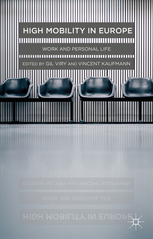
BOOK REVIEW: High Mobility in Europe: Work and Personal Life, edited by Gil Viry and Vincent Kaufmann

Debbie Hopkins‘ review of High Mobility in Europe: Work and Personal Life,  by Gil Viry and Vincent Kaufmann (Eds.)  critiques to question posed by the book and discusses the key contributions to knowledge and understanding.

She highlights that the book ‘provides critical insights into changing mobility practice and the intersection of work and personal lives’, despite being a little data heavy.   Read her full review here to understand more about the editors’ contributions to transport geography and other disciplines.

This review is published with the kind permission of Elsevier. It is  also available via Science Direct, published in The Journal of Transport Geography, Vol 55, Debbie Hopkins, High Mobility in Europe: Work and Personal Life. Gil Viry and Vincent Kaufmann (Eds.). 2015. Basingstoke, UK, and New York, US: Palgrave Macmillan. (£65.00 (hardback). ISBN 978-1-137-44737-1

BOOK REVIEW: Mobility: A New Urban Design and Transport Planning Philosophy for a Sustainable Future by John Whitelegg

Richard Knowles‘ review of John Whitelegg‘s book,  Mobility: A New Urban Design and Transport Planning Philosophy for a Sustainable Future, emphasises the author’s thematic approach to negating the dominant mobility paradigm.

Knowles strongly recommends this book to a range of audiences. Read his full review here.

This review is published with the kind permission of Elsevier. It is  also available via Science Direct, published in The Journal of Transport Geography, Vol 52, Richard Knowles, Mobility, J. Whitelegg, Straw Barnes Press, Church Stretton, Shropshire, UK, £6.99 (E-book), (2015), ISBN: 978-0-946309-02-3

Mobility: A New Urban Design and Transport Planning Philosophy for a Sustainable Future

This brand new book by John Whitelegg of the Stockholm Environment Institute sets out a rationale for a transformation of the mobility  landscape and argues that the sustainable transport options simply cannot thrive in a world that remains wedded to more mobility and the manifestations of that cultural and political bias (subsidy, infrastructure and an astonishing lack of attention to death, injury, air pollution, climate change and social justice).  See here for more information and await a review in the TGRG.

Continue reading Mobility: A New Urban Design and Transport Planning Philosophy for a Sustainable Future →