This session aims to consider the multiple dimensions along which time is a key feature of mobility and modal choice. For many decades, maximising mobility and minimising travel time were core objectives in transport planning. However, contemporary transport research offers a more nuanced picture of our travel needs and wants. Mobility has been found to be declining in developed economies – a phenomenon which has been termed ‘peak car’ – raising questions about the environmental, economic and social drivers of this change.
That digital technology can offer virtual, rather than literal, co-presence has, for some and in some instances, obviated the need to spend time travelling, as well as improved issues of accessibility e.g. online banking and shopping. In contrast, assumptions about the ‘cost’ of travel time have been undermined by a new appreciation of the potential quality and value of commuting time. Furthermore, there is a growing awareness of slower modes as means of supporting sustainable travel choices, and boosting health and wellbeing. Time is also a crucial factor in understanding and planning for transport need: considering urban form and scale, places and populations change over time, offering new challenges as depopulating areas struggle to support services while growing urban centres face increased demand and congestion. From large scale trends to more personal influences on travel decisions and residential locations, the life course offers another intersection between time, mobility and modal choice, as issues such as finding a livelihood, child-rearing or transitioning towards old age change our options and preferences.
We particularly welcome papers which engage with mobility and modal choice, linked to the themes of:
The experience or value of travel time
Slower modes for environmental sustainability, health and wellbeing
The influence of ICT on mobility, modal choice and accessibility
Age, period and cohort effects
Mobility and changing needs across the life course
Changing demographic socio-cultural and lifestyle factors
Policy and changing mobility needs
Urban or rural change and transport demand
Residential/service location and accessibility
Research methods
Please submit an abstract of up to 300 words by Tuesday 16th February to session convenors Dr Julie Clark and Dr Sara Tilley at:
ESRC funded PhD Studentship for DREAM CDT October 2016 Intake
This project aims to explore the relationship between (tele)commuting and weather. Researchers have spent significant effort in modelling the effects of weather conditions and also extreme weather events on commuting and transport infrastructure. Also, prior research has tried to understand the role that Information and Communication Technologies (ICTs) can perform as an enabling platform for working remotely and avoiding or decreasing physical commuting. This PhD project will build upon these two streams of research and also incorporate a risk dimension which is related to extreme weather and climate change. For instance, changes to the daily commute can be made during extreme weather (e.g. floods, heatwaves, snow), allowing commuters to select the mode of transport which is most resilient for the conditions. At the extreme, telecommuting can be seen as a powerful tool to increase resilience.
Cities are organised in space as complex urban networks, which are connected together through various diverse layers of infrastructure (from transport to digital infrastructure). These infrastructural layers vary from city to city and will affect the capacity of individuals to commute. With respect to telecommuting, the complexity of the above argumentation increases if we consider labour and housing markets. For instance, not every industry can support and take advantage of telecommuting opportunities. Similarly, people whose occupation enables telecommuting may reside in close proximity or in areas of similar socio-economic profile. For instance, problems with Internet broadband connectivity in rural areas might still be a deteriorating factor for working from home and avoiding physical commuting. This PhD project will build upon the above narrative and answer research questions related with the capacity of places and individuals to telecommute, the relation of telecommuting with with weather and extreme weather events, and the link between infrastructure – both digital and transport infrastructure – with telecommuting.
A key partnership with Enable ID has already been secured, which will provide a wealth of stream data in regards to personal mobility. This PhD project will introduce a framework of diverse analytical methods which include statistical analysis such as multi-level modelling, data mining, network analysis, spatial analysis and visualisation.
With four leading universities: Cranfield, Birmingham, Cambridge and Newcastle – and over twenty informatics industry organisations collaborating to deliver leading edge research and training through the DREAM Centre for Doctoral Training, all you have to decide is where you want to make a difference.
The DREAM CDT programme offers an attractive stipend with a strong professional development ethos. The programme provides a research experience combining academic rigour with real world problem solving, ensuring you have the opportunities to progress your career in the global informatics sector. Researchers will study for a PhD, benefiting from expertise, events and courses run at all four of the partner universities.
Application
If you are interested in joining us in DREAM to study for a PhD in Big Data, Risk and Environmental Analytical methods, the 2016 call for projects has now been opened for applications, closing on Friday, 26th February, 2016 at midnight. The application form is available here and needs to be sent by email to Dr Emmanouil Tranos.
Eligibility
*To be eligible for this funding, applicants must be a UK / EU national. We require that applicants are under no restrictions regarding how long they can stay in the UK i.e. have no visa restrictions or applicant has “settled status” and has been “ordinarily resident” in the UK for 3 years prior to start of studies and has not been residing in the UK wholly or mainly for the purpose of full-time education.
Call for papers for the 2016 RGS-IBG Annual Conference, 30th August – 2nd September 2016, London, UK.
Beyond and Across “Energy”: Addressing Nexus Challenges through Interdisciplinary, Integrative, and Inclusive Approaches
Sponsors: Transport Geography Research Group and the Energy Geographies Research Group
Organisers: Debbie Hopkins, Rebecca Ford, Ben Wooliscroft, Michelle Scott and Janet Stephenson (University of Otago, New Zealand) In order to ‘address the interdependencies, tensions and trade-offs between different environmental and social domains’, and transition to a more efficient, equitable and sustainable future, insights are required that go beyond traditional boundaries. In this session, we will explore interdisciplinary, integrative and inclusive approaches that provide novel and innovative ways of thinking about environmental and social problems. In particular, we are interested in the many roles of “energy” as a vector in social, economic and environmental outcomes. Energy underpins most daily activities and, in many forms, drives carbon emissions in both the global North and South through its sourcing, conversion, transmission, and residential (e.g. home lighting, heating, and transport), commercial, and industrial use. We call for papers that situate energy within the context of everyday human needs and activities (e.g. water, food, mobility, manufacturing) that step beyond interdisciplinary thinking, and that transcend the traditional sectoral silos.
In the last decade alone, a wide range of interventions, coming from a variety of theoretical perspectives and practical approaches, have been developed to bring about reductions in energy demand and carbon emissions. However these interventions are often embedded in a single academic tradition, and often overlook systemic interactions particularly between technical innovation and behaviour. The implications of these interventions on other challenges, such as water scarcity and food security, requires further consideration since the use of energy is deeply embedded within the physical and social contexts of daily life, and change will involve a wide variety of actors in all sectors of the economy and society.
In this session, we invite original, scholarly contributions, which can be empirical, theoretical or methodological in nature, and which may sit within one or more of the following themes (alternative themes are also welcomed):
* Reviews of the value and limitations of disciplinary and/or interdisciplinary research for understanding nexus challenges
* Theoretically, conceptually and/or empirically novel understandings of energy in a resource-constrained world
* Integrative approaches that acknowledge discipline-based ontologies
* Consideration of theories and methodologies that can aid understandings of transitions across varying geographical, political and cultural contexts
* The value of radical versus incremental transitions in achieving long-term systemic change
* Examinations of the justice and ethics of access to energy in a resource-constrained future
* Research-informed learnings with relevance for policy and practice across spatial scales
* Integrative and inclusive research within and beyond the academy
We are seeking abstracts (c.250 words) for oral presentations examining nexus challenges through interdisciplinary, integrative, and inclusive approaches. Abstracts and questions should be submitted to Debbie.hopkins@otago.ac.nz<mailto:Debbie.hopkins@otago.ac.nz> by Thursday 4th February. Notification of acceptance will be given by Tuesday 9th February.
On demand: cultural economies of access and ownership
Paper session at the RGS-IBG Annual International Conference 2016, London, 30 August – 2 September, 2016. Organisers: Brendan Doody (University of Cambridge) and Lizzie Richardson (University of Cambridge). Sponsors: TGRG
The ways resources are consumed and used are being challenged, renegotiated and reworked across various sectors. In this ‘post-ownership’ story, citizen-consumers are increasingly paying to access goods and services ‘on-demand’, which may be ‘shared’ with other users. Within the transport sector there has been a growth of car-sharing schemes, where drivers pay for access to and short-term use of a shared vehicle (Shaheen & Cohen, 2013; Kent and Dowling 2013; Belk, 2014). The shifting materialities of media continue to alter the relationship between cultural products and identities through the growth of on-demand streaming sites such as Netflix, Amazon Prime and Spotify (Moore, 2013; Tryon 2013; Bailey, 2015). Meanwhile, commercial and domestic spaces are being renegotiated through configurations of access that encourage temporary usage of the site itself (e.g., networked hospitality; co-working spaces) and flexible demand for resources within it (e.g., energy) (Molz 2012; Powells et al., 2014; Guttenberg, 2015).
We are interested in critical approaches that question and complicate the narrative of ‘post-ownership’ to describe these trends. Firstly, to what extent does access query normative understandings of, and practices associated with, ownership? Secondly, what are the implications of access for the qualities and/or quantities of resource usage? Thirdly, how are emotional and ethical attachments realised through everyday negotiations of access and flexibilities of demand?
We welcome papers dealing with issues related (but not limited) to:
a) Changing mode(l)s of access and ownership, together with their (cultural/economic/political/environmental) implications;
b) Empirical studies of how these mode(l)s are being operationalised and negotiated in everyday life (e.g., transport; space (domestic/commercial); media; energy, tools, clothes);
c) Their potential to blur, challenge and disrupt existing imaginaries and practices of access/ownership;
d) The ways in which digital, location-based and smart technologies are integrated into and integral to these mode(l)s;
e) The emotional and ethical implications of access-based and on-demand usage.
Applicants should submit an abstract (~200 words), including a preliminary title, to Brendan Doody (bjd47@cam.ac.uk) and Lizzie Richardson (er305@cam.ac.uk) no later than Friday 12th February 2016. The convenors will notify all authors of whether their paper can be accommodated in the session by Tuesday 16th February. Final confirmation of the session will be provided by the RGS-IBG conference organisers following the deadline for session proposals on 19th February.
The TGRG has a small prize for the best postgraduate presentation in any TGRG session at the RGS-IBG 2016 Conference. If you wish to enter for the Postgraduate Prize a full paper should be submitted to the Chair and Secretary of TGRG, prior to the conference date for judging. For more information and to find out about entry criteria please contact TGRG postgraduate rep Joanna Elvy (gy06jde@leeds.ac.uk).
References
Bailey, E. (2015). New audiences, new markets: Accessing music, art, and writing at your leisure. In D. Sarver Coombs & S. Collister (Eds.), Debates for the digital age: The good, the bad, and the ugly of our online world (pp. 3-22).
Belk, R. (2014). You are what you can access: Sharing and collaborative consumption online. Journal of Business Research 67 (8): 1595–1600.
Guttentag, D. (2015). Airbnb: Disruptive innovation and the rise of an informal tourism accommodation sector. Current Issues in Tourism 18 (12): 1192–1217.
Kent, J L., & Dowling, R. (2013). “Puncturing automobility? Carsharing practices.” Journal of Transport Geography 32: 86–92.
Molz, J. (2012). CouchSurfing and network hospitality: ‘It’s not just about the furniture’. Hospitality & Society 1 (3): 215–25.
Moore, C. (2013). Distribution Is queen: LGBTQ media on demand. Cinema Journal 53 (1): 137–44.
Powells, G., Bulkeley, H., Bell, S., & Judson, E. (2014). Peak electricity demand and the flexibility of everyday life. Geoforum, 55, 43-52.
Shaheen, S. A., & Cohen, A. P. (2013). Carsharing and personal vehicle services: Worldwide market developments and emerging trends. International Journal of Sustainable Transportation, 7(1), 5-34.
Tryon, C. (2013). On-demand culture: Digital delivery and the future of msovies. New Brunswick, N.J: Rutgers University Press.
Call for Papers for TGRG-sponsored session: Mobility, Transport and making Sustainable Places: a neglected Nexus
Convenors: Dr Kate Pangbourne (Aberdeen) and Dr Angela Curl (NZ)
The next RGS-IBG Annual International conference will take place at the Royal Geographical Society in London from the 30th August- 2nd September 2016 and will be chaired by Professor Peter Jackson (University of Sheffield). The conference theme is Nexus Thinking.
Profound disconnections remain between urban planning and transport planning. For a time, the sustainable development discourse that rose to prominence in the 1990s looked as if it might bridge this deep gulf, with an opportunity for integrating ‘Triple Pillar’ sustainability into governance processes. Instead, it created a new silo for sustainable development as separate to other governance domains. Consequently environmental governance remains separated from the process of governing of urban space. It is time to look again at building the nexus between mobility, transport and the making of sustainable places. Could climate change be the issue that finally establishes a nexus, or are other issues driving partial collaborations between policy domains? For example, in Scotland a ‘place standard’ has recently been developed in partnership by Scottish Government Architecture & Place, NHS Health Scotland and Architecture & Design Scotland, a partnership that notably does not explicitly include transport, though policy aims include promoting designing for compact, well-connected low-carbon places and advocating street design that prioritises pedestrians.
This session invites contributions that critically engage with the session theme. For example, contributions could focus on the following:
• •Examples of non/cooperation between policy silos at all levels of governance that promote sustainable mobility in the context of sustainable place-making (or vice versa)
• • Examples of community–led place-making initiatives that dispense with artificial top-down structures that constrain thinking about development in sustainable place-making
• • Evaluations of activities that can be related to place-making (e.g. Smarter Choices)
• • Discussions of the relationships between places that generate unsustainable movement
Abstracts of 300 words are invited from those interested in presenting current or recent research at this session, including an indication of the TYPE of presentation proposed. The objective is for a lively debate, therefore one potential format for this session would be to have up to 10 x 20 slide pecha kucha presentations (each lasting 6 minutes and forty seconds) followed by a response from a distinguished discussant and a panel discussion between the presenters and the audience. A mix of formats will also be considered. If you have a viewpoint proposal rather than research, or wish to discuss a potential contribution, you are welcome to contact the convenor.
Please submit proposals to Kate Pangbourne (k.pangbourne@abdn.ac.uk) by 10th February 2016.
We are inviting abstract submissions from postgraduate students to a TGRG sponsored session at the 2016 RGS-IBG Annual International Conference entitled “current and emerging research in transport”. This session is aimed at postgraduate students conducting research in any aspect of transport geography and related topics. The session is open-themed but we particularly welcome papers which tackle the wider conference theme of ‘Nexus Thinking’. In recent years we have seen an increase in the number and range of presentations in what is always a well-attended and interesting event. The session provides a relaxed atmosphere for postgraduates at any stage of their research to present their work in progress. Oral presentations in this session may be shorter in this session than in the main sessions if demand warrants. Presenters are encouraged to submit a paper for the Postgraduate Prize and priority will be given to papers intending to enter for the Postgraduate Prize.*
* The TGRG has a small prize for the best postgraduate presentation in any TGRG session at the RGS-IBG 2016 Conference. If you wish to enter for the Postgraduate Prize a full paper should be submitted to the Chair and Secretary of TGRG, prior to the conference date for judging. For more information and to find out about entry criteria please contact TGRG postgraduate rep Joanna Elvy (gy06jde@leeds.ac.uk).
If you would like to present a paper in this session, please submit the following information to the session convenors Joanna Elvy (gy06jde@leeds.ac.uk) and/or Clare Woroniuk (clare.woroniuk@newcastle.ac.uk) by Friday 29th January 2016.
* Title
* Authors, affiliations and email addresses
* Presenter
* Abstract (up to 300 words)
The 2016 Annual International Conference will be held at the Royal Geographical Society in London, from Tuesday 30 August to Friday 2 September 2016.
Queer Mobilities: LGBT Citizenship on the Move
Panel: Call for Participants
Annual International Conference, London, 30 August-2 September 2016
Royal Geographical Society (RGS) with Institute of British Geographers (IBG)
Sponsored session by the Transport Geography Research Group (TGRG) and Space, Sexualities & Queer Research Group (SSQRG)
Conveners: Professor Karen Lucas (Institute for Transport Studies, University of Leeds) and Dr Martin Zebracki (School of Geography, University of Leeds)
This panel will explore the under-examined topic of mobility transitions of lesbians, gays, bisexuals and transgender (LGBT) people as they experience and negotiate travel, migration and everyday living environments involving various modes of public and private transport from the local to the global and across physical, economic, sociocultural and virtual contexts.
Envisaging ‘queer’ as critical antipode of normative social practice, we especially welcome reflections on studies that introduce new, ‘queerying’ methodologies or ‘ways of looking’, and/or which seek to transform or transcend mobility environments in particular ways to become more sensitive to, inclusive of or critical towards citizenship identities, rights and responsibilities of LGBTs. This can be explored through reflexive practices or direct actions of the researcher and their participants at various geographical scales or communication of research messages to policymakers and practitioners.
Moreover, we would like to encourage contributors to ponder on the Nexus conference theme and to bring this to bear upon notions of place identity and ‘belonging in movement’ through and between explorations of (contra)normative experiences of LGBT performance in mobility.
Thus, we welcome critical accounts on LGBT citizenship ‘on the move’ as performed via mindset, behaviour, lifestyle, social interaction, etc. in multi-scalar transport contexts. Topics may include but are not limited to:
• Epistemologies of queer mobilities.
• Sexual differentialities within queer mobilities (e.g. ‘trans’mobility).
• More-than-human queer mobilities: human queers, queer artefacts and (e)motion.
• Queer mobilities and intersectionality (e.g. (dis)ability, intergenerationality, religion, ethnicity, class)
• Mobilities of queernormativity: (re)moving the queer norm.
• Queer travellers/migrants and the (il)legal body (cf. queer liberalism).
• Mobilities of the securitisation of the queer body (cf. homonationalism).
. Artistic queer mobilities.
• Policies of queer mobilities.
• Intra-urban queer mobilities.
• Digital vis-à-vis ‘offline’ queer mobilities / hybrid queer mobilities.
If you are interested in participating in this panel, please provide a max. 300-word statement and max. 100-word bio (including affiliation and e-mail address) to both of of us at K.Lucas AT leeds.ac.uk and M.M.Zebracki AT leeds.ac.uk by 12 February, 2015. Please contact us should you have any queries.
We are inviting abstract submissions to a Transport Geography Research Group sponsored session at the 2016 RGS-IBG Annual International Conference entitled “Interdependent Mobilities in Infrastructure Networks”. The conference will take place at the Royal Geographical Society in London from 30th August – 2nd September 2016.
If you are interested in presenting a paper in this session then please send a title, the names and affiliations of the authors, and an abstract (up to 300 words) to the session convenors (Simon Blainey, University of Southampton, S.P.Blainey@soton.ac.uk; Raghav Pant, University of Oxford, raghav.pant@ouce.ox.ac.uk; Scott Thacker, University of Oxford, scott.thacker@ouce.ox.ac.uk) by Monday 8 February 2016.
There has in recent years been an increasing focus in both research and policy on considering infrastructure networks as interdependent systems, rather than as separate interconnected entities. This has resulted from a recognition that the functionality of transport, energy, water, waste, and ICT networks is inextricably linked, with their efficiency, effectiveness and resilience dependent on their connectivity to the other systems with which they interact. The importance of such interdependencies has been reflected in policy making, with the recent establishment of a National Infrastructure Commission by the UK government, and in the development of a range of research projects focusing on network interconnections (in other words, on infrastructure nexus thinking).
Infrastructure interdependencies are by their nature highly spatial, and because infrastructure networks are characterised by movement and mobility the theme of infrastructure nexus thinking has particular relevance to transport geography. Such interdependencies can be found at scales from the local (e.g. the effect of charging point availability on electric vehicle take-up levels) to the global (e.g. the impact of changing recycling patterns on global commodity flows), meaning that they have relevance to a range of research areas.
This session will focus on the geographies of interdependency between transport and other infrastructure networks, examining how nexus thinking can 1) enhance existing approaches to dealing with and exploiting infrastructure interdependencies, in order to realise a more efficient, equitable and sustainable use of transport infrastructure and 2) help understand and address the impacts of interdependencies on society. Paper topics might include (but are not limited to):
– Visualising and modelling interdependencies and linkages between multimodal transport networks and other infrastructure networks.
– Examining how the tensions and trade-offs between transport and other infrastructure systems are played out across and influenced by space.
– Considering how transport network interdependencies shape and are shaped by the societies with which they interact.
– Examining individual experiences of transport infrastructure interdependence.
– Assessing how the mobilities of individuals are enabled, affected or constrained by interdependencies with other infrastructure systems.
The TGRG has a small prize for the best postgraduate presentation in any TGRG session at the RGS-IBG 2016 Conference. If you wish to enter for the Postgraduate Prize a full paper should be submitted to the Chair and Secretary of TGRG, prior to the conference date for judging. For more information and to find out about entry criteria please contact TGRG postgraduate rep Joanna Elvy (gy06jde@leeds.ac.uk).
It is said that on average, we take 66 days to form a new habit. So when an initiative sets out to change our habits in just 24 hours, there’s cause for scepticism. World Car-Free Day aims to do just that. The thought is that by closing city centres to cars for one day a year, people will make a long-term switch to alternative modes of transport and help us to address the many problems caused by our dependence on cars.
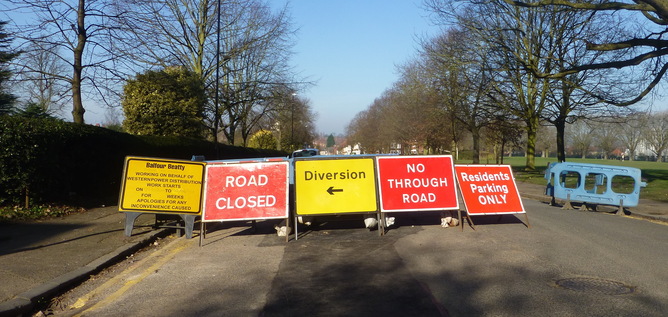
Car-free days have been running for almost 20 years, with cities as far afield as Washington, Paris, Brussels, Stockholm and New Delhi participating. And though the impact of these initiatives has not been well evaluated, there are studies which suggest that events which disrupt the transport system can lead to longer term behaviour changes. Strikes and road closures, for example, force people to try something different, and alter their knowledge and perceptions of the travel alternatives on offer.
One worldwide 2002 study of over 70 road closures due to natural disasters and planned roadworks found that, on average, 11% of vehicles previously using the road could not be found in the surrounding area afterwards. A more recent study on the impact of strike action on the London Underground in February 2014 used data from travel cards to examine travel patterns before, during and after the strike. It found that 5% of travellers carried on using their newly discovered routes after the disruption was over.
While these findings sound encouraging, it’s worth questioning whether the changes to travel patterns after a disruption are any greater than the day-to-day variability we see anyway. And if they are, there’s still no guarantee that enough people maintain these changes for long enough to alter overall travel patterns, such as the total kilometres driven from one year to the next.
A three-year study on these topics confirmed that individual travel patterns undergo significant day-to-day and year-to-year churn. For instance, although over half of those who were asked by the researchers before and after the 2012 Olympics in London said they had changed their journeys to work during the games, three quarters said they did not always travel to work the same way on a typical day anyway.
Similarly, half of council employees in York revealed they could not be certain how many days they would travel in to the office in the following week. The study revealed that these variations were due to myriad reasons, from changing family and work schedules, avoiding bad weather or just feeling like making a change.
Get multi-modal
But if there’s so much churn and flexibility in the system already, why is it so difficult to achieve deep reductions in car use? For these reductions to materialise, we need more people to avoid taking single occupancy journeys in their car more of the time, so that being “multi-modal” – that is, relying on more than one mode of transport – becomes the norm.
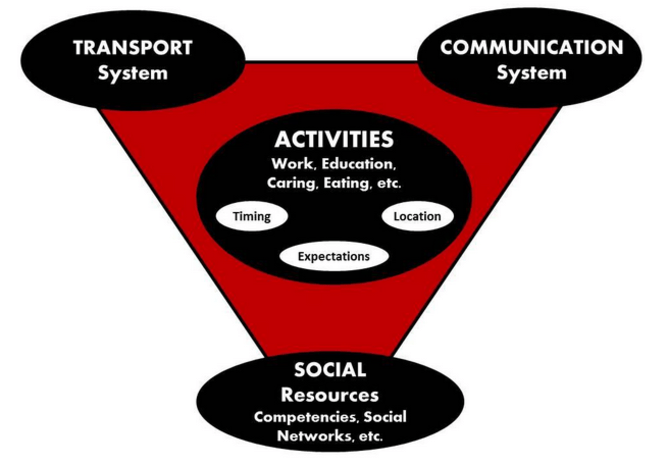
But to achieve this, we’ll need a much broader understanding of how and what shapes people’s travel choices in the first place, and how this varies across locations and societal groups. The three-year disruption study suggests that we should think about these issues in terms of a broader “mobility system”.
The mobility system includes not only the transport system (infrastructure, legislation, fiscal arrangements like charges and fares, and public transport operators), but also the communication system (patterns of work, shopping and socialising as well as the information we use on the go) and the social context (the norms about how things are done, the know-how and resources of those in the system, including workplaces and communities).
At the centre of the mobility system are the activities which each generate travel and are influenced by the institutions and expectations in the system, such as school start and end times, or standardised business hours.
The mobility system. Jillian Anable/Disruption Project, Author provided
Unfortunately, the supporters of car-free day – like most policy targeting transport patterns – fall into the trap of thinking that altering the transport infrastructure and services is all that’s required to alter travel behaviour. While these initiatives can play a role in changing the behaviour of some people, for one day, occasionally, it is far from adequate to influence longer term changes at the scale required. Instead, we need to make changes across the whole mobility system, to continually reinforce greater uptake of alternative transport methods.
Flexible working hours, which relax rigid time and place constraints is an important part of the solution, as is wraparound childcare (such as before- and after-school clubs) to allow flexible schedules. Transport system solutions include payment systems to cater for multi-modal journeys such as the Mobility Mixx card in the Netherlands, which can be used to pay for all public transport, taxis, car pool, bike and car rental and park-and-ride tickets. Another option is seasonal reallocation of road space to pedestrian spaces or non-motorised road users as they did in New York.
We need to think more carefully about how, where and when activities are carried out, and then look at how transport provision fits with that. Only then could car-free days go from being rare annual events to part of making non-car journeys more likely, more of the time.
Accessibility, the ease with which an individual can get to destinations, is now well established as a social justice issue in transport planning. In 2003, Making the Connections, a report by the Social Exclusion Unit highlighted poor accessibility as one of the multi-faceted aspects leading to social exclusion. This resulted in many transport practitioners engaging with issues of transport-related social exclusion and issues of inequality through the process of Accessibility Planning. However, efforts were largely focused around the quantification and measurement of access to destinations in order to produce threshold based accessibility targets. A database of accessibility statistics covering the whole of England at zone level was also produced. Such attempts at quantification have been critiqued, especially in the context of understanding social exclusion, for their black box approach, which fails to understand the lived experience of (in) accessibility and its potential impacts.
However, another source of data, the National Travel Survey (NTS) has been largely underutilised in this regard. Between 2005 and 2012 there was a bank of questions in the NTS, which asked how long it would take respondents to reach the nearest of each of a set of destinations using public transport or walking; this has recently been replaced by a computer generated ‘objective’ measure [i],[ii].
Increasingly, moves towards big data and the ability to link to administrative records means that we may be able to replace information previously asked in social surveys with official records. For example, rather than asking people about their health, we might be able to access their health records. But there may be some cases, where understanding an individuals’ perception of their health is more important than a record of visits to the GP. It is therefore crucial to be clear about what we can and cannot understand by asking certain questions in a survey, or by replacing them with information from large scale datasets. The same applies to the replacement of this set of questions in the NTS with objective measures.
It seems timely to consider what might be gained from including the question regarding self-reported journey times to destinations and what the implications of excluding it might be in terms of our understanding of accessibility. What does this change in measurement technique mean for the way in which we understand accessibility to local services based on the NTS data and does the move away from self-reported data have any implications?
According to the NTS guidance, the previous question in the survey was an objective measure:
“These questions are measures of fact, not of opinion. Interviewers are encouraged to make use of information other than that provided by the household if this provides a more accurate indication of the true position. ‘Walk time’ assumes a walk speed of three miles per hour, and takes no account of, for example, any infirmity or disability of the respondent” (NTS 2006, p.60)[iii].
On this basis, the move in the latest NTS to include ‘objective’ measures of accessibility calculated using TRACC, utilising geo-coded destinations and public transport timetables based is a positive development towards including a measure which is more comparable across the sample and is not affected by individual’s experience of the time taken or definition of what might constitute a grocery store, for example. However, while the objective potential accessibility provided by the transport and land use system is important for understanding the opportunities an individual does or does not have, when trying to address issues of transport and social inclusion it might be that how an individual perceives or really experiences accessibility is more important in determining their travel behaviour, and subsequently outcomes which may or may not contribute to processes of social exclusion.
In the National Travel Survey, there is however no indication of whether interviewers did override respondents answers or not and given that responses are self reported (either by the respondent or the interviewer) they are by nature subjective and likely to be influenced by individuals’ abilities and constraints, rather than being an indication of any ‘objective’ or ‘factual’ level of service provision. I have previously compared the NTS survey question to another nationwide objective dataset of public transport journey time access to destinations, the DfT Accessibility Statistics using data from the same year and at comparing at the postcode sector level and found socio-spatial differences between self reported and objective measures. The very fact that differences exist, suggests that the NTS was not as ‘accurate’ as an objective measure as was intended, again supporting the change of methodology towards one which does not rely of self-report or interviewer reports. However, the fact that differences exist also highlights that there is variation in self reported levels of accessibility compared with objective measures, which has implications in terms of policy interventions and targets to improve accessibility.
The new linked data includes a caveat that it is not directly comparable to the previous questions due to the change in methodology. This is clear from Figure 1, which shows clear shifts in the proportion of the population with access to each type of destination between 2012 and 2014. While not dramatic they do show a clear departure from previous trends and extrapolated to the population might have considerable impact. For example, the increase from 22% to 25% of the population having access to a hospital within 15 minutes, equates to 1.8 million people (based on 2012 and 2015 mid-year population estimates for England). This might have substantial implications for planning and policy decisions around accessibility to hospitals, and lead to a possibly incorrect assumption that accessibility has improved against targets. It is clear that the change in methodology has affects destinations differently, some showing and increase and some a decrease. It is also likely that there change has differential impact geographically and across socio-demographic groups. Unfortunately, by not including the two approaches in the same survey year, it is not possible to evaluate the impact of this change in methodology, although we can speculate as to what some of the implications might be, it is not possible to control for any actual changes over time.
Figure 1 suggests that there may be a difference in the definition of destinations between self-reported responses and the dataset used to calculate objective measures. The increased proportion of the population who can reach a hospital, GP or post office according to the new measure might be interpreted as meaning that there are more destinations in a national dataset than would be considered in a subjective choice set. On the other hand, we might assume that, particularly for hospitals, these are infrequent journeys which might be reported times are longer due to unfamiliarity. Familiarity has previously been reported as a reason explaining the ‘accuracy’ of journey time estimations.
Figure 1 – Percentage of population who can access a given destination within 15 minutes by public transport or walking based on the National Travel Survey 2005-2014 (excluding 2013). For some destinations the data for 2008 has been imputed by taking the mean of 2007 and 2009 as the data is not available for all destinations for this year.
Individual difference is one of the main reasons for disparities between the two types of measure. A place based measure cannot encapsulate the different travel experiences of all those living in a particular place. In my thesis I found that older people and car drivers reported longer journey times than measured objectively. There are two potential mechanisms at play here: in some cases differences occur because of inaccuracies in objective measures, for example because of the spatial scale used or the destinations included; differences may also occur because self reported measures are not accurate, relative to the objective measure. Differences may occur because an individual is not aware of a particular journey or destination, issues of familiarity or perceiving unfamiliar journeys to be longer than they are, or because a journey actually does take longer for an individual than an objectively measured average, because of mobility constraints such as children or older age.
Therefore, for some population groups, the differences between the TRACC and survey question data may be much larger than others, which leads us to think about what implications this might have for issues of social inclusion in transport planning. While contour mapping and cumulative accessibility measures might demonstrate that certain population groups are more likely to be at risk of transport related social exclusion, the fact that some of these groups may perceive accessibility to be worse than an objective measure would suggest could mean that they are at even greater risk of social exclusion. On the other hand, people may adapt to adverse circumstances and therefore not report problems, highlighting the need to compare self reported measures to objective measures.
If we can calculate public transport accessibility to destinations at the population level (using either the CAI or TRACC) then the value of attaching this data to a representative sample and then using this to extrapolate to the population seems limited. Would it not be better to have the national dataset available separately and keep the NTS as a survey which can be linked to a whole range of other data sets? One clear benefit, of course, is the ability to link data regarding accessibility to destinations to the rich information available in the NTS, which presents a range of research opportunities outwith the scope of the discussion here. The NTS had value in understanding how individual’s experiences might differ from an objective ‘norm’ (or at least a self reported measure, which did not intend to represent an objective reality, would).
The NTS is a continuous survey, designed to measures change over time. The change of methodology undermines this role. It should be remembered that the DfT reverted to traditional travel diary methods following a trial of using GPS to replace the traditional travel diary element of the NTS due to large discrepancies which meant that the use of the NTS as an ongoing measure of travel behaviour would be limited. This is not to say that the GPS data, or in this case, objective measures of accessibility are not useful, but it must be remembered that they measure something different to questions asked in a social survey. The nature of the knowledge is different, and evidence showing differences should make it clear that we need both kinds of knowledge to address issues of inclusion in transport.
The focus here has been on journey time, which is an important component of accessibility to destinations. However, for those at risk of transport related social exclusion, it may not be the most important factor and more work is needed to understand the importance of other aspects of accessibility across the social spectrum. A greater understanding of how perceptions differ from objective measures, for whom and why is crucial to addressing exclusion as it might illuminate why some groups feel unable to access destinations, despite measures which otherwise suggest reasonable levels of accessibility.
Transport planning has been criticised for its positivist approach, considering averages and not individuals’ experience. In this regard the change in methodology would appear to be a backwards step, moving away from understanding how individuals experience access to destinations. Of course, both approaches to measurement are needed if we are to make any progress in improving accessibility against a baseline. But while much academic research and professional practice has focussed on objective measurement of accessibility, perceptions have recently been highlighted as an important area for future research, at the very same time as the NTS is moving away from asking people what they think in favour of trying to capture the ‘reality’.