
Tag Archives: walking

RGS TGRG session final call – MARGINALISED PARTICIPATION: EXPERIENCES AND BARRIERS IN THE BORDERLANDS OF ACTIVE TRAVEL

Conveners: Dr Juliet Jain Juliet.Jain@uwe.ac.uk and Dr Billy Clayton William2.Clayton@uwe.ac.uk

Abstract

Marginalised participation: Experiences and barriers in the borderlands of active travel

It is well established that increasing levels of walking and cycling will benefit people’s health and wellbeing, and their broader quality of life (Curl and Clarke 2019).  Thus policy interventions, medical trials, and emergent digital innovations have sought different ways to promote and engage adults and children with walking and cycling, especially in response to the consequences of an inactive population.   

The link between increasing physical activity and improvements in health in general focuses on the able majority, but for many people the initial hurdle is being able to walk a few metres rather than kilometres.  People, therefore, may find themselves on the margins of participation with active mobility simply because there are more barriers and fewer opportunities for those with a disability and/or complex health needs (physical and/or emotional).  For some, access to specialist equipment (e.g. adapted cycles) or additional support is limited.  The transition to active travel will not be easy for all, as the barriers are multiple and varied.  Yet despite health and disability presenting barriers, there are other individual narratives of extreme levels of walking or cycling as a response to (or in spite of) physical or mental health conditions.  Thus narratives around active mobility and health and wellbeing are likely to be varied and complex, and may require new theoretical or methodological approaches for interpreting or generating insights of what active mobility represents, as well as health or wellbeing, in the borderlands. 

This session encourages submission of papers either empirically or theoretically based that offers new insights to the topic of walking or cycling for health.  This may include, but is not limited to:

  • Disability and cycling/walking
  • Walking/cycling with health conditions
  • Novel methodologies for researching walking/cycling and health
  • Digital technology and walking/cycling for health
  • Place and therapeutic landscapes in the context of walking and cycling
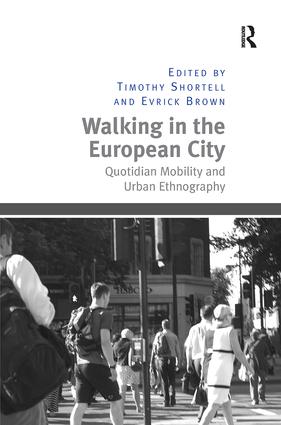
BOOK REVIEW: Walking in the European City: Quotidian Mobility and Urban Ethnography

Denver Nixon reviewed Walking in the European City: Quotidian Mobility and Urban Ethnography, edited by Timothy Shortell and Evrick Brown

He found that whilst this book may not be perfectly suited to researchers into active modes, and that the book had other shortcomings, it contains ‘some enlightening nuggets and provocative contentions’.  The full review is available here.

This review is published with the kind permission of Elsevier. It is  also available via Science Direct, published in The Journal of Transport Geography, Volume 62, 2017.  Denver Vale Nixon, Book Review: Walking in the European City: Quotidian Mobility and Urban Ethnography, T. Shortell, E. Brown (Eds.) (2014), (Burlington,
VT: Ashgate. £95.00 (hardback)) ISBN 9781472416162 (hbk).

‘Walking & Cycling: The contributions of health and transport geography’ session at RGS 2013

This session was co-sponsored  by the TGRG and the Geography of Health Research Group (GHRG).  It brought together what appeared to be an eclectic mix of presentations exploring the contribution of geographers’ research in active modes.

Firstly Anna Davidson’s‘A political ecology of the body in urban cycling’, looked at the potential for new theoretical approaches to understanding the interaction between the cyclist and their environ, then Esther Rind and colleagues used a modelling approach to explore whether a measure of environmental quality impacts upon active travel behaviours.  David Lindelöw presented a compelling argument for more research into walking as a mode of transport, then drew on principal component analysis to examine factors influencing walking. His work drew parallels with Maslow’s hierarchy of need after the work of Alfonzo (2005).  Rachel Lee and Rebecca Johnson each presented case studies evaluating interventions to encourage active travel, using a Pecha Kucha style; a copy of Rachel’s can be view below.  Rachel focussed upon how Living Streets’ community partnership approach to delivering environmental improvement encouraged walking, whilst Rebecca evaluated the role of adult cycle training in promoting confidence in Tower Hamlets.  Each emphasised the ability of simple and relatively cheap interventions to facilitate behavioural change.

The session proved that despite the breath in approach, in reality there was a strong link between each paper with themes such as community, health, the built environment, policy (and in some case politics) and practice being emphasised throughout.


 [slideshare id=26226849&style=border:1px solid #CCC;border-width:1px 1px 0;margin-bottom:5px&sc=no] 

Rachel Lee’s pecha kucha presentation. 

Continue reading to see the accompanying text. Continue reading ‘Walking & Cycling: The contributions of health and transport geography’ session at RGS 2013 →