Tag Archives: cycling

RGS TGRG session final call – MARGINALISED PARTICIPATION: EXPERIENCES AND BARRIERS IN THE BORDERLANDS OF ACTIVE TRAVEL

Conveners: Dr Juliet Jain Juliet.Jain@uwe.ac.uk and Dr Billy Clayton William2.Clayton@uwe.ac.uk

Abstract

Marginalised participation: Experiences and barriers in the borderlands of active travel

It is well established that increasing levels of walking and cycling will benefit people’s health and wellbeing, and their broader quality of life (Curl and Clarke 2019).  Thus policy interventions, medical trials, and emergent digital innovations have sought different ways to promote and engage adults and children with walking and cycling, especially in response to the consequences of an inactive population.   

The link between increasing physical activity and improvements in health in general focuses on the able majority, but for many people the initial hurdle is being able to walk a few metres rather than kilometres.  People, therefore, may find themselves on the margins of participation with active mobility simply because there are more barriers and fewer opportunities for those with a disability and/or complex health needs (physical and/or emotional).  For some, access to specialist equipment (e.g. adapted cycles) or additional support is limited.  The transition to active travel will not be easy for all, as the barriers are multiple and varied.  Yet despite health and disability presenting barriers, there are other individual narratives of extreme levels of walking or cycling as a response to (or in spite of) physical or mental health conditions.  Thus narratives around active mobility and health and wellbeing are likely to be varied and complex, and may require new theoretical or methodological approaches for interpreting or generating insights of what active mobility represents, as well as health or wellbeing, in the borderlands. 

This session encourages submission of papers either empirically or theoretically based that offers new insights to the topic of walking or cycling for health.  This may include, but is not limited to:

  • Disability and cycling/walking
  • Walking/cycling with health conditions
  • Novel methodologies for researching walking/cycling and health
  • Digital technology and walking/cycling for health
  • Place and therapeutic landscapes in the context of walking and cycling

GIS for Transport Applications workshop

The TGRG-sponsored ‘GIS for Transport Applications’ workshop took place in Leeds earlier this month. It was was the most popular of all workshops put on as part of the GIS Research UK (#GISRUK) conference. The aim was simple: to showcase and develop the growing expertise of Geographical Information Systems within the Transport Community.

Read below to hear about this event and see links to the free online tutorials developed for it.

Winning map from the ‘GIS4TA’ workshop
Continue reading GIS for Transport Applications workshop →

Irish Transport Research Network Cycling Workshop, Limerick

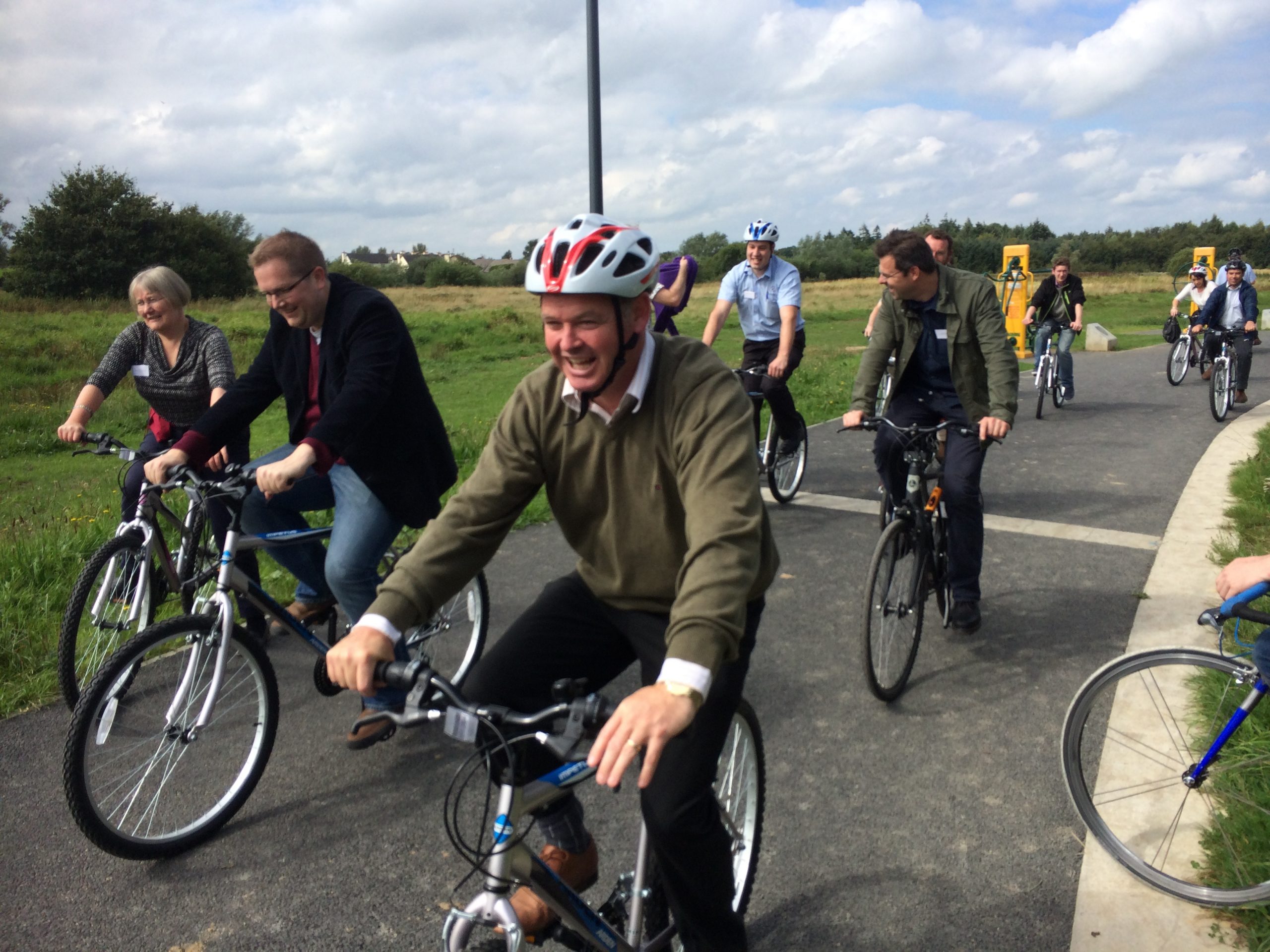
The Irish Transport Research Network preceded their 2014 annual conference, at the University of Limerick, with a cycling-focused workshop celebrating Limerick’s position as a demonstration city for smarter travel.

The workshop took place on the 3rd September and effectively brought together practitioners, policy makers and researchers from across Ireland for both the workshop and the conference.

Continue reading Irish Transport Research Network Cycling Workshop, Limerick →

Cycling and Active Travel

This was a broad yet deep overview of the state of cycle infrastructure as a specialist topic of expertise for civil engineers. John Parkin, Professor of Transport Engineering at the University of the West of England. To put this in context, it was part of an event on cycling organised by the Institution of Civil Engineers. Below you’ll find a very short write-up of the talk and, more importantly, a copy of John’s excellent slides and a link to an audio recording of the talk.

The talk built on the recent addition of the Institution’s of the Cycling Working Group. Creating a dedicated cycling group in this esteemed Institution is a small but significant step towards integrated transport planning in the UK and, as John says, it is inspiring to see that this group was primarily motivated by students – the new generation of civil engineers – rather than by a top-down process. This was one of the most informative and enjoyable talk on cycling I’ve seen in a long time. So sit back, hit ‘play’ in the soundcloud box and enjoy the ride.

[soundcloud url=”https://api.soundcloud.com/tracks/157835985″ params=”auto_play=false&hide_related=false&show_comments=true&show_user=true&show_reposts=false&visual=true” width=”100%” height=”50″ iframe=”true” /]

Leeds-Bradford ‘cycle superhighway’: a paradigm shift?

Yesterday an event called “Cycling – the Future?” took place, organised jointly by the Institution of Civil Engineers (ICE) and the Chartered Institute of Logistics and Transport (CILT), hosted at Leed’s MET University.  Below you will find a brief write-up of the event as well as some excellent slides.

[soundcloud url=”https://api.soundcloud.com/tracks/157130823″ params=”auto_play=false&hide_related=false&show_comments=true&show_user=true&show_reposts=false&visual=false” width=”30%” height=”50″ iframe=”true” /]

Continue reading Leeds-Bradford ‘cycle superhighway’: a paradigm shift? →

Jon Orcutt on how New York became a cycle friendly city

The presentation below is truly inspiring, demonstrating how simple measures can encourage cycling in even the most car-dominated of cities. Jon Orcutt is the Policy Director of New York’s Department of Transport and has seen cycling more than double in his time at the top. See this process in action and listen to how this happened in his own words, below:

Continue reading Jon Orcutt on how New York became a cycle friendly city →

Modelling on the Move: Cycling and Transport Modelling

The Modelling on the Move seminar series has reached it’s 6th iteration, and is now open for booking.

The topic is Cycling and Transport Modelling is now open for booking and a provisional timetable will be available soon. Please see http://modellingonthemove.org/events/modelling-on-the-move-6-cycling-transport-modelling/ for more information and to register your interest in the event. Do feel free to share the details of the event with colleagues who might be interested.

Barriers to cycling and policy implications

This was a fascinating presentation delivered by Ann Jopson from Leeds Institute of Transport Studies (ITS) at an event entitled “The Challenges of Sustainable Mobility in our Cities”. In it, new data is presented on people’s attitudes towards cycling and explanations as to why so few people do cycle regularly despite widespread positive intentions surrounding active travel. The event was not filmed; fortunately I brought my audio recorder along and Ann kindly sent me the slides, allowing an audio-visual slide sharing experience. So please see below, sit back and enjoy the talk.

Continue reading Barriers to cycling and policy implications →

‘Walking & Cycling: The contributions of health and transport geography’ session at RGS 2013

This session was co-sponsored  by the TGRG and the Geography of Health Research Group (GHRG).  It brought together what appeared to be an eclectic mix of presentations exploring the contribution of geographers’ research in active modes.

Firstly Anna Davidson’s‘A political ecology of the body in urban cycling’, looked at the potential for new theoretical approaches to understanding the interaction between the cyclist and their environ, then Esther Rind and colleagues used a modelling approach to explore whether a measure of environmental quality impacts upon active travel behaviours.  David Lindelöw presented a compelling argument for more research into walking as a mode of transport, then drew on principal component analysis to examine factors influencing walking. His work drew parallels with Maslow’s hierarchy of need after the work of Alfonzo (2005).  Rachel Lee and Rebecca Johnson each presented case studies evaluating interventions to encourage active travel, using a Pecha Kucha style; a copy of Rachel’s can be view below.  Rachel focussed upon how Living Streets’ community partnership approach to delivering environmental improvement encouraged walking, whilst Rebecca evaluated the role of adult cycle training in promoting confidence in Tower Hamlets.  Each emphasised the ability of simple and relatively cheap interventions to facilitate behavioural change.

The session proved that despite the breath in approach, in reality there was a strong link between each paper with themes such as community, health, the built environment, policy (and in some case politics) and practice being emphasised throughout.


 [slideshare id=26226849&style=border:1px solid #CCC;border-width:1px 1px 0;margin-bottom:5px&sc=no] 

Rachel Lee’s pecha kucha presentation. 

Continue reading to see the accompanying text. Continue reading ‘Walking & Cycling: The contributions of health and transport geography’ session at RGS 2013 →