
Category Archives: News

RGS-IBG 2019 session – paper call: Long-distance travel, social change and climate change: troubles ahead?

We would like to invite abstracts for our proposed session for RGS-IBG Annual Conference 2019 on the topic of “Long-distance travel, social change and climate change: troubles ahead?” – sponsored by the Transport Geography Research Group.

Convenors: Dr Giulio Mattioli, (Department of Transport Planning, TU Dortmund University), Prof. Joachim Scheiner (Department of Transport Planning, TU Dortmund University) Dr Zia Wadud (Institute for Transport Studies and Centre for Integrated Energy Research, University of Leeds)

Long distance passenger travel – whether domestic or international – accounts for a small share of trips, but a large share of travel distances, energy use, and carbon emissions. Despite the recent excitement about ‘peak car’, traffic volumes are growing on motorways, trunk roads and railways in the UK, and CO2 emissions from international aviation in the EU have more than doubled since 1990. Non-work and leisure activities play a big role here, and a number of broad social trends (e.g. transnationalism, migration, ICT, changing nature of work, individualisation, ageing) have a clear bearing on these developments. Yet our understanding of the social, economic and lifestyle drivers of long-distance travel demand is still limited.

This session welcomes both theoretical and empirical contributions to help advance our understanding of the link between social change and growing travel demand in the long-distance sector and their potential implications in terms of energy and carbon emissions. All topics under this general theme are welcome, some suggestions are: 

•           long-distance travel and urban form / built environment (including residential self-selection effects)

•           intensive long-distance travel among sectors of population commonly perceived as environmentally minded (e.g. urbanites, young adults, academics), and strategies to cope with the resulting ‘attitude-behaviour’ gap

•           comparative assessments of trends in everyday and long-distance travel

•           linkages between different types of ‘mobilities’ (e.g. migration, residential relocation, multilocality) and long-distance travel

•           biographical and life-course perspectives on long-distance travel

•           travel-intensive leisure practices

•           impact of long-distance travel on environmental outcome

•           policy, stakeholders’ and activist perspectives on long-distance travel

•           policies to curb long-distance travel demand and related acceptability challenges

•           the impact of emerging transport technologies and services on long-distance travel

•           spatial dispersion of social networks and long-distance travel in an ICT-intensive society

You are invited to submit abstracts of between 200-300 words by email to giulio.mattioli@tu-dortmund.de by 3rd February 2019. We will then select the best submissions for our full session proposal which will be submitted to RGS in mid-February. We expect to have final confirmation of acceptance by end March 2019.
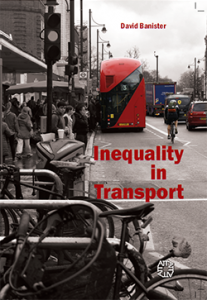
Inequality in Transport by David Banister

David Banister has just published a new book Inequality in Transport – now available through amazon kindle https://www.amazon.co.uk/dp/B07F2QMS6X/ price £9.99
And it will be published as a paperback on 12th July through Alexandrine Press – Price £30.00 – p. 272 and in full colour. The whole enterprise has been self-publication.

It will also be linked through David’s website – http://www.tsu.ox.ac.uk/people/dbanister.html and through Alexandrine Press – http://www.alexandrinepress.co.uk/built-environment
There is also a website for the book https://www.inequalityintransport.org.uk/

Everyone needs transport to move around and to access everyday needs, but for each individual those needs are different, and they change over time and space: herein lie the seeds of inequalities in transport. In Inequality in Transport, David Banister addresses this complex problem, first through an exploration of inequality, its nature, measurement and extent. He then links inequality and the transport sector through detailed analysis of the variations in daily and long-distance travel in Great Britain over a ten-year period. He argues that there must be a much wider interpretation of inequality – one that links actual travel with measures of wellbeing and sustainability, recognizing that these will change over time. In drawing his findings together, he concludes that there must be new thinking in transport policy and planning if transport inequalities are to be alleviated.

Global Challenges in Transport Programme: Health, Wellbeing and Transport course (5-8 December 2017)

We have a few places still available on the Health, Wellbeing and Transport course, to be held Tuesday 5th- Friday 8th December 2017, at Kellogg College, University of Oxford.

The course is part of our Global Challenges in Transport programme, which provides researchers and practitioners with the necessary knowledge, skills and expertise, supported by the latest research evidence, to address the complexity associated with making transport sustainable.

This course considers health, wellbeing and social equity across spatial scales, geographical contexts and transport modes. It specifically concentrates on the relationships between urban form and design, mobility practices, and physical and mental well-being. Particular emphasis will be placed on the potential contribution of walking, cycling and public transport services to healthy cities.
Our speakers include: Dr Tim Schwanen (TSU), Prof Karen Lucas (ITS), Dr Jennie Middleton (TSU), Dr Christian Brand (TSU), Dr James Esson (Loughborough University), Dr Margaret Peden (The George Institute for Global Health), Dr Audrey de Nazelle (Imperial College London), Emma Aldrich (Marie Stopes Uganda), Dr Adrian Davis.

The full programme is available at: http://www.tsu.ox.ac.uk/course/hwt2017.pdf

This is a 4-day residential course, with fees covering all materials, 21 contact hours, and 3 night’s en-suite accommodation at Kellogg College, University of Oxford. All meals and refreshments are provided. The fee structure is as follows:

· Private sector: £3,500
· Public sector: £1,500
· PhD: £500

We are able to offer partial scholarships to a limited number of participants, as well as discounts to those attending several Global Challenges in Transport courses.

Further details about all courses in the Global Challenges in Transport programme can be found at www.tsu.ox.ac.uk/course

To enquire or apply, please email exed@tsu.ox.ac.uk

Global Challenges in Transport programme at the University of Oxford: Governing Transitions in Urban Transport (27 – 30 June 2017)

The Transport Studies Unit at the University of Oxford is currently accepting applications for the Governing Transitions in Urban Transport course, to be held 27th – 30th  June 2017, at Kellogg College, University of Oxford.

The course is part of our Global Challenges in Transport programme, which provides researchers and practitioners with the necessary knowledge, skills and expertise, supported by the latest research evidence, to address the complexity associated with making transport sustainable. Specifically the Governing Transitions in Urban Transport course explores how technological, behavioural and institutional transitions in urban transport can be facilitated and steered through policy and planning.

Our speakers include: Prof David Banister (TSU), Prof Glenn Lyons (UWE Bristol), Dr Jennie Middleton (TSU), Dr Tim Schwanen (TSU), Dr Louise Reardon (ITS Leeds), Dr Michael Synnott (WBS), Dr James Palmer (TSU). The full programme is available at www.tsu.ox.ac.uk/course

This is a 4-day residential course, with fees covering all materials, 21 contact hours, and 3 night’s en-suite accommodation at Kellogg College, University of Oxford. All meals and refreshments are provided (including a welcome lunch, a formal networking dinner and an end-of-course dinner). The fee structure is as follows:

  • Corporate rate: £3,500
  • Academic/Public sector rate: £1,500
  • PhD rate: £500

We are able to offer partial scholarships to a limited number of participants, as well as discounts to those attending several Global Challenges in Transport courses.

Further details about all courses in the Global Challenges in Transport programme can be found at www.tsu.ox.ac.uk/course

To enquire or apply, please email exed@tsu.ox.ac.uk

A Truly Integrated Transport System for Sustainable and Efficient Logistics

SETRIS Deliverable “A Truly Integrated Transport System for Sustainable and Efficient Logistics”.This document provides a holistic overview of a truly integrated transport system as the vision to reach significant advances in terms of efficiency, effectiveness and sustainability of freight transport and logistics, creating value and adding competitiveness to all manufacturing and retail sectors in Europe and supporting the achievement of societal challenges associated to freight transport. Read the pdf here. [https://v.gd/smzJZw]

The document has been prepared in the frame of SETRIS project and the contents have been reviewed and approved by the five transport European Technology Platforms (ETP): ERTRAC, ERRAC, ACARE, ALICE and WATERBORNE.

Congratulations to David Smith, the 2016 TGRG Undergraduate Dissertation Prize Winner.

We would like to congratulate David Smith for his achievement in winning the TGRGs best undergraduate dissertation prize.  David recently earned his BA in Geography at the University of Oxford.  For the prize, David will receive books to the value of £150 from Edward Elgar.  His dissertation abstract can be found below.  Comments from the judges include: “This ethnographic study of a Welsh heritage railway is detailed and conceptually ambitious. David demonstrates familiarity with concepts in economic and cultural geography, and blends that with mobilities concepts to develop his concept of ‘working mobilities’ in the context of heritage transport. His thesis is also beautifully written, which helped David’s work to stand out above the other ten candidates, all of whom had undertaken interesting and varied work, demonstrating the breadth of interesting topics and approaches that can be used in modern transport geography.”

“Working Mobilities”: Labours, Movements and Moorings at the Ffestiniog and Welsh Highland Railways

This dissertation attends to the different kinds of work that enable mobility to take place. Drawing together ideas from both economic and cultural geography as well as mobilities scholarship, the term ‘working mobilities’ is coined and developed to refer to the labours, practices, performances and personal implications of transport work. Drawing on ethnographic fieldwork undertaken over nine weeks at a heritage railway in Snowdonia during the summer of 2015, the analysis is arranged around three main themes: working, moving and mooring, in order to expand on this hitherto overlooked facet of mobilities.

The first, ‘working’, applies Linda McDowell’s scholarship on ‘body work’ into a heritage railway setting, finding it to be a combination of both old and new forms of labour. Physical work is involved in facilitating mobilities on a literal level – shovelling coal and cleaning floors, for instance. Meanwhile, ‘new’ forms of labour are present too – the body itself becomes a performance through helping to produce particular atmospheres. But skills and knowledges are important too – places are comprehended multi-sensually through combinations of official and tacit knowledges, whilst specific skills are learnt, again directly enabling the smooth operation of mass mobility.

Next, ‘moving’ explores the relationship between those working mobilities and the equipment they use. A series of micro-movements by human subjects combine to form significant, meaningful movements on much larger scales, such as those gestures which signal that all is ready for a train to proceed. Meanwhile, the vehicles of mobility themselves hold complex, multi-scalar subjective meanings to those who work mobilities, and even when apparently insignificant, retain the capacity to move us emotionally. One particular example is examined in detail.

Finally, ‘moorings’ examines the importance of the relationships of fixity and movement which exist for railway workers, through three registers; spatially, socially, and temporally. Each of these can only be considered relationally, but each is important in providing structure and meaning to the people who work mobilities, and thus enabling them to carry out their duties. Examples include the importance of stationary, as opposed to mobile staff – for instance signallers – and the depth of attachment that comes about through long-lived connections to forms of mobilities – continuities through the life course.


For more information regarding the undergraduate prize please contact the TGRG secretary, Simon Blainey.

Call for TGRG session proposals: RGS-IBG Annual International Conference 2017

Dear TGRG members,

The call for sessions and papers for the 2017 RGS-IBG Annual International Conference is now open and we would like to invite TGRG members to submit session proposals for next year’s conference.

The conference will take place at the Royal Geographical Society in London from 29th August- 1st September and will be chaired by Professor Sarah Radcliffe (University of Cambridge). The conference theme is ‘Decolonising geographical knowledges: opening geography out to the world’.  We would particularly encourage sessions around this theme, but sessions relating to any aspect of transport geography will be considered.

If you would like to have your session sponsored by TGRG, please submit your session proposal to S.P.Blainey@soton.ac.uk AND K.J.Pangbourne@leeds.ac.uk by Friday 16th December. We will confirm session sponsorship as soon as possible and you will then have until Friday 17th February to send out your Call for Papers, choose your presenters and submit your full session proposal to RGS.

Please include the following in your session proposal (you do not have to use the AC2016 session proposal form at this stage):

  • A title
  • Names, affiliations and email addresses of the session convenors (we advise TWO)
  • A session abstract (about 200-300 words), and up to five keywords.

Guidance – sessions are scheduled into timeslots of 1 hour 40 minutes long. A session may not normally occupy more than two of these timeslots in the conference programme. TGRG has a ‘ration’ of timeslots, which we will bear in mind when selecting which proposals to sponsor. Please indicate how many high quality papers you think you will attract – four or five (max) ‘traditional’ papers will fit into a timeslot, or you can consider holding a debate, or a workshop, or adopt a different format such as a pecha kucha.

We welcome joint proposals with other groups (who may have a different timeline – please state what that is). For session proposals which attract many high quality submissions, we will consider allowing two timeslots – there are usually 2 or 3 sessions which have two timeslots each.

In addition to promotion of sessions and support in submitting session proposals, one of the benefits of a TGRG sponsored session is that we are given an allocation of guest passes for non-geographers and/or non UK conference participants. Session organisers may suggest names of established speakers for whom the TGRG can potentially offer a free conference pass, assuming the criteria for guest passes are met and subject to our allocation of guest passes. We also have a prize for the best paper by a postgraduate researcher presented in any TGRG sponsored session.

The following link may be useful in proposing your session:

http://www.rgs.org/WhatsOn/ConferencesAndSeminars/Annual+International+Conference/Annual+international+conference.htm

Best wishes,

Simon Blainey (TGRG Secretary)

PhD opportunity: (Tele)commuting, cities and weather conditions

ESRC funded PhD Studentship for DREAM CDT October 2016 Intake

This project aims to explore the relationship between (tele)commuting and weather. Researchers have spent significant effort in modelling the effects of weather conditions and also extreme weather events on commuting and transport infrastructure. Also, prior research has tried to understand the role that Information and Communication Technologies (ICTs) can perform as an enabling platform for working remotely and avoiding or decreasing physical commuting. This PhD project will build upon these two streams of research and also incorporate a risk dimension which is related to extreme weather and climate change. For instance, changes to the daily commute can be made during extreme weather (e.g. floods, heatwaves, snow), allowing commuters to select the mode of transport which is most resilient for the conditions. At the extreme, telecommuting can be seen as a powerful tool to increase resilience.

Cities are organised in space as complex urban networks, which are connected together through various diverse layers of infrastructure (from transport to digital infrastructure). These infrastructural layers vary from city to city and will affect the capacity of individuals to commute. With respect to telecommuting, the complexity of the above argumentation increases if we consider labour and housing markets. For instance, not every industry can support and take advantage of telecommuting opportunities. Similarly, people whose occupation enables telecommuting may reside in close proximity or in areas of similar socio-economic profile. For instance, problems with Internet broadband connectivity in rural areas might still be a deteriorating factor for working from home and avoiding physical commuting. This PhD project will build upon the above narrative and answer research questions related with the capacity of places and individuals to telecommute, the relation of telecommuting with with weather and extreme weather events, and the link between infrastructure – both digital and transport infrastructure – with telecommuting.

A key partnership with Enable ID has already been secured, which will provide a wealth of stream data in regards to personal mobility. This PhD project will introduce a framework of diverse analytical methods which include statistical analysis such as multi-level modelling, data mining, network analysis, spatial analysis and visualisation.

Supervisors: Dr Emmanouil Tranos and Dr Lee Chapman

About DREAM CDT

With four leading universities: Cranfield, Birmingham, Cambridge and Newcastle – and over twenty informatics industry organisations collaborating to deliver leading edge research and training through the DREAM Centre for Doctoral Training, all you have to decide is where you want to make a difference.

The DREAM CDT programme offers an attractive stipend with a strong professional development ethos. The programme provides a research experience combining academic rigour with real world problem solving, ensuring you have the opportunities to progress your career in the global informatics sector. Researchers will study for a PhD, benefiting from expertise, events and courses run at all four of the partner universities.

Application

If you are interested in joining us in DREAM to study for a PhD in Big Data, Risk and Environmental Analytical methods, the 2016 call for projects has now been opened for applications, closing on Friday, 26th February, 2016 at midnight. The application form is available here and needs to be sent by email to Dr Emmanouil Tranos.

Eligibility

*To be eligible for this funding, applicants must be a UK / EU national. We require that applicants are under no restrictions regarding how long they can stay in the UK i.e. have no visa restrictions or applicant has “settled status” and has been “ordinarily resident” in the UK for 3 years prior to start of studies and has not been residing in the UK wholly or mainly for the purpose of full-time education.

Congratulations to Sam Comber, TGRG Undergraduate Dissertation Prize Winner

Congratulations to Sam Comber, from University of Birmingham who has been awarded this year’s prize for the best undergraduate dissertation in Transport Geography, sponsored by Ashgate. The judges were impressed with the advanced statistical approach and overall methodology which went ‘well beyond those normally seen in undergraduate geography dissertations’ and felt that the dissertation overall was ‘extremely high quality’.

Sam’s abstract is below:

This paper evaluates the willingness to pay for rail investments by home-buyers. The investments examined are the Crossrail intervention in Ealing that will improve the Great Western Main Line’s service provisions. As Crossrail is currently incomplete, this paper studies the anticipation effect derived from Crossrail’s mid-2008 announcement. Anticipated benefits of rail investments should factor into home-buyers location choice criteria because of the future transport cost savings. Studying the Crossrail intervention, a three-stage regression approach is introduced to explore the nuances between the estimates of cross-sectional, spatial cross-sectional and quasi-experimental approaches (using difference-in-difference estimators). In doing so, this paper investigates the research hypothesis that Crossrail’s announcement increased housing prices, and that these increases reflected proximity to Crossrail stations. The findings concluded by this paper suggest there are statistically significant premiums for properties located nearer to the sites of planned Crossrail stations following the post-announcement period.