All posts by TGRGadmin

TGRG Annual General Meeting / Expert Panel Discussion: AGM Agenda and Reminder to Register

If you are a TGRG member and have not yet done so please don’t forget to register to attend the TGRG AGM which will be held on Wednesday September 8th 2021 via Zoom, with at 14:00 UK time an Expert Panel discussing the question ‘What next for Transport Geography post-Covid?‘, and the AGM itself at 15:00 UK time. The meeting will be finished at 16:30. 

The Expert Panel consists of Maria Attard, University of Malta; Simon Blainey, University of Southampton; Janet Dickinson, University of Bournemouth; and Frank Witlox (Editor-in-Chief, Journal of Transport Geography), University of Ghent. So it promises to be a very interesting afternoon.

Those members of TGRG who are also Members or Fellows of RGS-IBG will also be able to vote in the associated elections for the TGRG Committee. We have the following Committee positions vacant and open for nominations this year. Nominations (in each case from a Proposer and a Seconder) should be made by 1700 UK time on Tuesday September 7th, by e-mail to the TGRG Secretary (john@mobihub.com). If you need more information about any of the posts please contact the Secretary, John Austin, at john@mobihub.com.

Web and Social Media Officer – The period of the post is 3 years.

Postgraduate Representative (2 posts) – This position is specifically held by a current (at the time of the AGM) postgraduate student member of TGRG. The position is responsible for promoting postgraduate interests and needs to the wider TGRG and maintaining connection with the wider postgraduate community through the Postgraduate Forum and other social media, supporting postgraduate student members, and planning and executing events and workshops. The term is for 1 year only. However, it is hoped that where the Postgraduate Representative has not already been a member of the Committee, that they would expect to be willing to stand for subsequent re-election in the following year.

Please e-mail nominations, including a proposer and seconder, to the TGRG Secretary ( john@mobihub.com ) by 17:00 UK time on Tuesday September 7th.

We will also be seeking confirmation at the AGM, from the TGRG membership, of Tara Tanöz-Sargeant as our Awards & Prizes Coordinator for a further 2 years (making 3 years in the post in total). Tara was co-opted onto the Committee as our Awards & Prizes Coordinator after the 2020 AGM following no nominations being received for the post by the time of that AGM.

Please note that you do not have to attend the AGM to be nominated or express an interest in a committee position.

To register to attend the AGM (before17:30 UK time on Tuesday September 7th, please), use the following link. https://forms.gle/mM3SnSqQqxdiVLod9

If you have any difficulties registering for the AGM, please email the TGRG Secretary, John Austin, at john@mobihub.com

Those who have registered to attend the AGM by the required time will be e-mailed a link for the Zoom meeting

The agenda is shown below, and those who register to attend will also be sent the agenda and papers by E-mail.

Wednesday 8th September 2021

TGRG ANNUAL GENERAL MEETING 2021

AGENDA

1ApologiesJohn Austin
2Minutes of last meeting;
Matters arising
John Austin
3Chair’s ReportHelena Titheridge
4Treasurer’s Report, including Motion to affirm the use of Co-op as our bankers for another yearCraig Morton
5Membership ReportEsther Anaya Boig
6Other Reports 
 Website and social media reportBilly Clayton
 Postgraduate report, including PG Prize announcementsZhengyue Wan
 Undergraduate Prize announcements – 2020 entrantsTara Tanöz-Sargeant
 JTG Editor’s Report inc. Book Reviews ReportFrank Witlox
 TGRG Book Series ReportJohn Austin – on behalf of Richard Knowles
 IGU Commission on Transport and GeographyChia-Lin Chen
7Elections Postgraduate Reps (* 2);
Website and Social Media Officer;
Confirmation of Prizes and Awards Co-ordinator
Helena Titheridge
8Any Other Business (including Questions)Helena Titheridge

HURRY – TIME-LMITED SPECIAL OFFER ON TGRG BOOK SERIES

To celebrate the RGS-IBG Annual International Conference Edward Elgar Publishing is offering 50% discount on all its Geography print books until Sunday 5th September 2021. Enter the code GEOG50 at checkout on http://bit.ly/3mYNDGu. This offer includes the Transport, Mobilities and Spatial Change Book Series shown at https://transportgeography.org.uk/transport-mobilities-and-spatial-change-book-series/

TGRG 2021 AGM – Notice, and invitation to register to attend

We are pleased to announce that the TGRG Annual General Meeting 2021 will be held on Wednesday September 8th 2021 at 3 p.m. (1500) BST, via Zoom, and will be preceded at 2 p.m. (1400) BST by an Expert Panel Discussion on ‘What next for Transport Geography post-Covid?’, for which speakers will be announced shortly. 

All members of TGRG are welcome to attend. Those members of TGRG who are also Members or Fellows of RGS-IBG will also be able to vote in the associated elections at the AGM for the TGRG Committee.

To register to attend the AGM (including the Expert Panel Discussion), please use the following link. https://forms.gle/mM3SnSqQqxdiVLod9

If you have any difficulties with using this link please email John Austin at john@mobihub.com. The registration is a two-stage process, and once you have registered with this link we will send you a link from Zoom for you to register on Zoom for the meeting itself. We will also email out an agenda and reports to all those who have registered one week before the AGM.,

We have the following Committee positions vacant and open for nominations this year. Nominations (in each case from a Proposer and a Seconder) should be made by Wednesday September 1st, by e-mail to the TGRG Secretary (john@mobihub.com). If you need more information about any of the posts please contact the Secretary, John Austin, at john@mobihub.com. 

Web and Social Media Officer – This is an important role, as it is critical for TGRG’s publicity and for its engagement with the membership. Responsibilities include leading the strategy and activity on our Website, Twitter account and LinkedIn group. The period of the post is 3 years.

Postgraduate Representative (2 posts) – This position is specifically held by a current (at the time of the AGM) postgraduate student member of TGRG.  The position is responsible for promoting postgraduate interests and needs to the wider TGRG and maintaining connection with the wider postgraduate community through the Postgraduate Forum and other social media, supporting postgraduate student members, and planning and executing events and workshops. The term is for 1 year only. However, it is hoped that where the Postgraduate Representative has not already been a member of the Committee, that they would expect to be willing to stand for subsequent re-election in the following year. 

Any TGRG member is welcome to apply.

Please e-mail nominations, including a proposer and seconder, to the TGRG Secretary ( john@mobihub.com) by Wednesday September 1st.

We will also be seeking confirmation at the AGM, from the TGRG membership, of Tara Tanöz-Sargeant as our Awards & Prizes Coordinator for a further 2 years (making 3 years in the post in total). Tara was co-opted onto the Committee as our Awards & Prizes Coordinator after the 2020 AGM following no nominations being received for the post by the time of that AGM.

Please note that you do not have to attend the AGM to be nominated or express an interest in a committee position. 

RGS-IBG Annual Conference Programme now Finalised

The Programme of the Conference is now finalised and TGRG has an extensive programme of Sessions (13 in all). Direct links to full information on all our Sessions are given below: most sessions will be presented virtually only (but still live), but our key Session (the Brian Hoyle Lecture) will be in-person. Register for virtual attendance at the Conference on the RGS-IBG Website here.

The Brian Hoyle Lecture on Transport Geography will be delivered on Thursday 2nd September at 15:00 by Professor Bert van Wee, from TU Delft, The Netherlands

Coworking spaces: a tool to reduce commuting and enhance well-being during the COVID-19 pandemic (1)

Coworking spaces: a tool to reduce commuting and enhance well-being during the COVD-19 pandemic (2)

The presence and impact of spatial boundaries in transport geography

New directions in aviation, distance and the environment (1)

New directions in aviation, distance and the environment (2)

Transport Planning and Governance in Times of Crisis – Changing Practices and Effects on Sustainable Transport

The politics of mobility futures (1)

The politics of mobility futures (2)

Current and Emerging Research in Transport (1)

Current and Emerging Research in Transport (2)

Challenges and opportunities for reducing car dependence in urban neighbourhoods

The New Boundaries and Borders of Electrified ‘Motoring’

NEW TGRG WEBSITE ADDRESS – transportgeography.org.uk

TGRG is delighted to announce that we have a new website address: www.transportgeography.org.uk. Please bookmark this and use it in future rather than our previous address at WordPress.

Although the new website looks little different from the old one we have taken this opportunity to make sure that everything is up-to-date, added a couple of new articles and, with the permission of Elsevier, added links to an extra 30 + Book Reviews from the pages of ‘Journal of Transport Geography’

‘Bus Back Better’ – Transport Geographers are vital to its success

John Austin writes a blog-piece about why Geographic Toolboxes & Skillsets are essential for delivering the strong bus networks envisioned in England’s new National Bus Strategy. And why, in his view, lessons from Research with a Transport Geography focus are vital to understanding what does and what does not work

This article originally appeared as a posting on LinkedIn

——————————————————————————————

The long-awaited National Bus Strategy for England was finally launched on March 15th, with the personal stamp of the Prime Minister: “I love buses” he writes in his Foreword.

It’s visionary, with a statement that ‘Buses are at the centre of the public transport network, making 4.07 billion journeys in England in 2019/20, more than twice as many as the railways’, leading its Introductory chapter. It’s also written with a desire for rapid progress. ‘Buses are the easiest, cheapest and quickest way to improve transport.      Better bus services can be delivered in months.’

Yet it’s also prescriptive, with the government offering the continuance of the discretionary public money that the industry needs as a result of the pandemic ONLY in return for a commitment to establish Enhanced Partnerships (or to begin the statutory process of Franchising) by each of the 81 English Local Transport Authorities (LTAs), together with the writing of a Bus Service Improvement Plan. This money is in the form of CBSSG (COVID-19 Bus Services Support Grant): there to maintain local bus networks as we begin to emerge from the pandemic, with a continued lower level of bus patronage as we stay at home and as our commuting patterns reflect a permanent change from Covid-19’s legacy.

Those actions by LTAs are required very quickly: with the commitments as above required by the end of June this year, and the publication of a local Bus Service Improvement Plan (to be updated annually and reflected in the LTA’s Local Transport Plan) needed by the end of October. From April 2022 LTAs will only be able to access the new discretionary streams of funding available if by that date they have an Enhanced Partnership in place or are following the statutory process required to consider a franchising scheme.

That will require a lot of work, in order not only to deliver Agreements and Plans that tick the government’s boxes but, of course more importantly, also to ensure that they are both ‘fit for purpose’ and are the RIGHT ones. In his always-excellent Bus and Train User blog, referring to theNational Bus Strategy, Roger French writes ‘One of the few detailed funding commitments in the document is £25 million to give “LTAs the skills and people they need to deliver this strategy” in 2021/22. Frankly, there’s only one thing worse than remote based bus company management designing bus networks for local areas, and that’s even remoter based consultants advising unskilled local authorities what their local bus network should look like.”

To help avoid that potential disaster Local Authorities and operators would be very well-advised to have Geographers at the heart of the teams delivering this. The National Bus Strategy has ‘Geographic’ written all over it. People with interpretive geographic skills, an understanding of geospatial software, and the ability to quickly gain local knowledge, or possessing it already – a key skill of geographers – will be essential practitioners right at the heart of delivery of the strategy.

Geography generally is about seeing the relationships between different places, different communities and different objects and about drawing the implications; about identifying patterns in the data based on evidence; about seeing how and why some things pertaining to spatial relationships change over time and why others stay the same.

Economic geographers understand how and why these relationships impact on the economy – through their effects on individuals, on businesses, on institutions and on the economy generally. Geographic Information Systems (GIS) specialists understand the minutiae, the benefits, and the pitfalls, of the software systems and processes used to model geographic behaviour and relationships. And transport geographers bring all these together with their analysis focussed on flows, movement, and transition.

What will the National Bus Strategy have to deliver if it is to succeed? Well, first of all, better performance. There will be no increase in bus service patronage, no making buses a mode of first choice rather than of last resort, no raising of the product quality, without bus priority to give better reliability. And the Strategy states that ‘There must be significant increases in bus priority’. That requires geospatial data on the details and the patterns of where buses are at different times of day and under different conditions; and it requires the bus operators, in partnership with the local transport authority, to have both the software and the trained, experienced control staff to enable a quick response to situations on the ground.

In the largest of the big cities – those with Mayoral Combined Authorities – Key Route Networks, with (the implication) key bus corridors – will need to be defined and controlled according to the Bus Service Improvement Plan. This will require an understanding of the relationships between different sections of route, and between different communities served by those corridors.

The National Bus Strategy places great emphasis on Networks and it recognises the importance of the relationship between services, places, times, and area features. It acknowledges that different areas need different types of networks (e.g. ‘Superbus networks for “intermediate” areas – neither fully urbanised nor deeply rural’). This requires geographic understanding. The link between areas is recognised in the Strategy through the desire for more through fares, easily available.

This link is also acknowledged in the desire to have integration of service patterns between modes: ‘Railway stations should be hubs for connecting services with high quality stops close to station entrances. Schemes that move buses further away from stations should not be allowed’. Bus network design and scheduling skills will be needed, with the ability to recognise and design flexible, attractive, demand responsive services, centred around hubs.

Place Design is also important to designing bus networks that are attractive. Geographical concepts of proximity, connectivity and links are all critical, and Local Transport Plans will be encouraged to recognise that, being centred on place-based strategies with a place-based approach to investment. At a more detailed level, local geospatial data is important, with a need to have accessibility data about bus stations and bus stops. The National Bus Strategy assures us that the government ‘will make sure that apps can provide passengers with accessibility data about bus stations and stops’.

This emphasis on both timeliness and accuracy is also shown in the Strategy’s call for up-to-date static and understandable passenger information, of which geospatial accuracy is a key part. ‘A number of apps and websites give inaccurate information when tested. Web searches for particular routes often also bring up old timetable PDFs which have since changed. Every town, city and rural area should have published, up to date maps.’

All this is great – as long as the funding is there. In referring to the £3bn ‘new funding’ Roger French writes in his blog “Let’s not get too dewey eyed about an amount previously unheard of in bus sector financial support circles because it’s got to last for five full funding years. And not just five unprecedented years of an inevitable slow recovery from the Covid shock of plummeting demand and changed lifestyles and travel patterns but a five year period of funding unprecedented aspirational improvements for buses that this strategy promises.”

When the funding runs out there will be an inevitable danger that activity in the bus sector will be cut back sharply (as has happened on occasions in the past). So it is essential that in this period there are lessons learnt about what works and what doesn’t, and also a monitoring of how realistic the Bus Service Improvement Plans have proved to be. All these provide invaluable lessons for the future. This is where Research with a Transport Geography focus will come into its own as the spatial thinking involved in that will be essential to a full understanding.

In my view the research should be objective-driven and focused on one (or two or all) of three areas. Firstly, the commercial needs of partners: notably bus operators, but also any partner organisation providing services, infrastructure or facilities supporting bus networks. Secondly, of course, bus passengers and bus potential passengers. Thirdly, the policy and community objectives of partners involved in bus networks and of the groups they represent. This group of partners will be most notably local authorities and other relevant public sector bodies; but could also include community organisations and business entities.

There will be several key areas for research which involves spatial relationships and relies on geographic insight as a major element. One major one is sustainable business models to take us beyond the £3bn new funding. Another is research into principles and success factors for the design of networks, nodes and links which involve fast bus corridors and cost-effective demand-responsive services enabling connectivity into and out of the nodes. A third is research into the usability of and attitudes towards the maps and interchange features introduced as part of Bus Service Improvement Plans. There are many more.

If Geographers are not involved at the heart of rolling out and monitoring the National Bus Strategy then government, operators, their passengers, and the whole community will have lost out.

POSTGRADUATE FORUM MIDTERM CONFERENCE SESSION: Women in the UK transport sector: where are we now and where are we going

Convenors: Zhengyue Wan (TGRG) & Olivia Engle (GFGRG)

Zhengyue Wan reports on the recent joint TGRG / GFGRG session at the RGS-IBG Postgraduate Forum Midterm Conference, held Monday 19th – Friday 23rd April  2021.  

Although feminist geographers and women in the transport sector have been advancing gender perspectives on mobility, their contributions to safe, inclusive, and sustainable transport are insufficiently acknowledged. Postgraduates, especially female students, might be confused about how to get into the transport sector and what they can do to improve the gender parity of transport after they have graduated. Therefore, this session invited five female transport practitioners from government, consultancies and industries as panel members to share their experiences and perspectives with postgraduate students on working as a woman in the transport sector. The panel members included (1) Sarah Wixey as the Associate Director from Net Zero Emissions Transport at Tetra Tech Europe; (2) Helen Mathews as the Head of Corporate Planning at Nexus; (3) Lynn Sloman as the Director of Transport for Quality of Life; (4) Lucy Mahoney as the Senior Manager of Walking and Cycling of C40 Cities, and (5) Kris Beuret as the Director of Social Research Associates.

 This session started with the host giving a brief introduction on the session and raising examples on the current gaps in the move towards sustainable and gender-inclusive transport. Then the panel members discussed the following questions combining both their background and working experiences:

(1) What made them interested in the transport sector and did they have any female transport practitioners as their role models?

(2) Have they experienced any particular challenges working as a woman in the transport sector?

(3) How are they and their organisations working to promote women working in the transport sector?

(4) How are they and other female colleagues making transport more gender-inclusive, feminist or sustainable?

(5)What are the future directions for gender-inclusive transport? and

(6) What are the future directions for women working in the transport sector?

The panel members raised gaps in the current transport system for female employees, such as sexual harassment and income inequity, and told about how they managed to overcome the difficulties and to improve the working environment for female transport practitioners. Some of the panelists shared their career progression in detail, and explained why they converted from other fields such as energy industry to the transport sector. Based on these questions, they also provided valuable suggestions on how women postgraduates can move towards working in the transport sector.

 In the following Q&A session, the panel members answered questions raised by the audiences, such as what universities can do to help female postgraduates with their future career progress in the transport sector. Audiences also shared their own experiences and their thoughts related to gender issues in transport. This session has attracted not only postgraduate students but also senior lecturers, which can be a starting point for building up a network for female transport-related students and practitioners in the future.

BOOK REVIEW: A Companion to Transport, Space and Equity

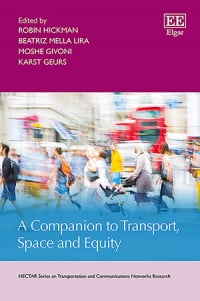
Richard Knowles reviewed ‘A Companion to Transport, Space and Equity’, edited by Robin Hickman, Beatriz Mella Lira, Moshe Givoni and Karst Geurs.

“Transport has a significant role in facilitating access to activity sites, but this varies markedly amongst different population groups. The aim of this book is to increase understanding of the linkages between transport, space and social equity. The four editors bring together wideranging research evidence from Global North and Global South countries in 21 chapters, from 42 researchers. This large group is an impressive mix of established and young researchers based in 11 Global North and three Global South countries”

You can read the full review here.

This review is published with the kind permission of Elsevier. It is  also available via Science Direct, published in The Journal of Transport Geography, Volume 94, 2021. Companion to Transport, Space and Equity, R. Hickman, B. Mella Lira, M. Givoni, K. Geurs (Eds.).
Edward Elgar Publishing, Cheltenham UK & Northampton
MA, USA (2019). ISBN 978 1 78811 981 8 (cased) £160; ISBN 978 1 78811 982 5 (eBook)

BOOK REVIEW: The vessels of the desert and the steppes: camelids in Antiquity (Camelus dromedarius and Camelus bactrianus)

Gabriel Camara reviewed ‘Les vaisseaux du desert et des steppes: les camelides dans l’Antiquite (Camelus dromedarius et Camelus bactrianus), The vessels of the desert and the steppes: camelids in Antiquity (Camelus dromedarius and Camelus bactrianus’, edited by Damien Agut-Labordere and Berangere Redon.

You can read the full review here.

This review is published with the kind permission of Elsevier. It is  also available via Science Direct, published in The Journal of Transport Geography, Volume 94, 2021. Les vaisseaux du d´esert et des steppes: les cam´elid´es dans l’Antiquit´e (Camelus dromedarius et Camelus bactrianus), The vessels of the desert and the steppes: camelids in Antiquity (Camelus dromedarius and Camelus bactrianus) by Damien Agut-Labordere and Berangere Redon (Eds.). 2020. Lyon: MOM Editions,
292 pp. £17.68/€19.99 (eBook). ISBN: 9782356681768.

BOOK REVIEW: Measuring Transport Equity

Laura Walker reviewed ‘Measuring Transport Equity’, edited by Karen Lucas and Karel Martens with Floridea Di Ciommo and Ariane Dupont-Kieffer.

” For practitioners in transport and spatial planning, this book provides a valuable collection of tools and approaches for measuring equity of social, economic and environmental outcomes. The nature of the approaches allows for further development or adaption and application to a range of scenarios and geographical areas.”

You can read the full review here.

This review is published with the kind permission of Elsevier. It is  also available via Science Direct, published in The Journal of Transport Geography, Volume 92, 2021. Measuring transport equity, Karen Lucas and Karel Martens with Floridea Di Ciommo and Ariane Dupont-Kieffer. (Eds.), Elsevier (2019). ISBN. (9780128148181).