All posts by Gaurav Mittal

2026 Hay Award Announcement

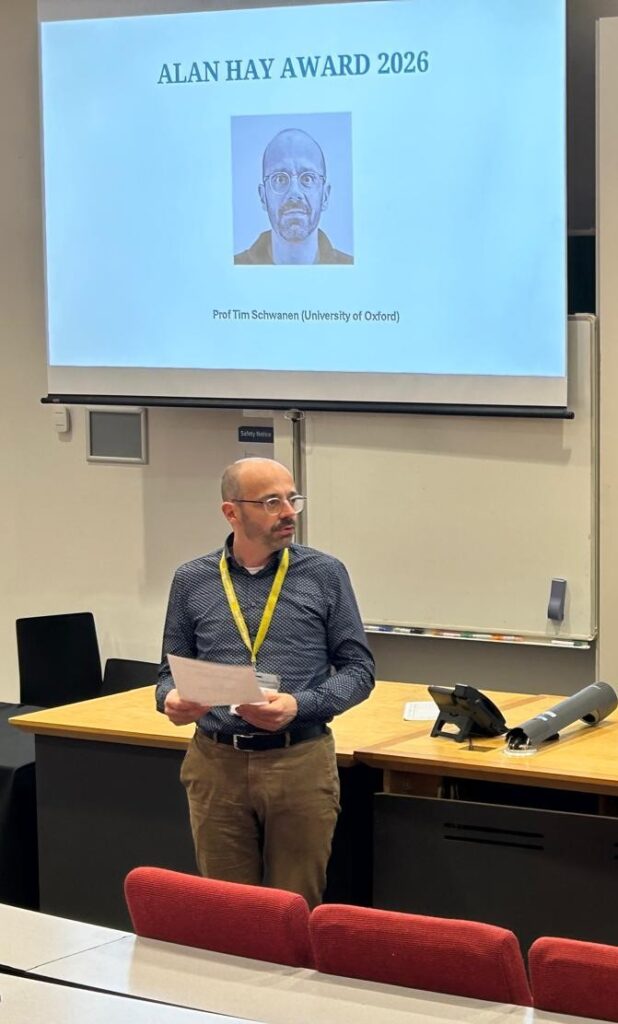
It is our great honour to announce this year’s recipient of the Hay Award: Professor Tim Schwanen.

The Alan Hay Award is presented annually in recognition of an outstanding contribution to transport geography. The 2026 award marks the 17th presentation of the Alan Hay Award, and the TGRG Committee is delighted to recognise Professor Schwanen’s distinguished and wide-ranging contributions to the field.

Professor Tim Schwanen is Professor of Transport Geography, Director of the Transport Studies Unit, and Research Fellow at St Anne’s College at the University of Oxford. He obtained his PhD cum laude from the Department of Human Geography and Planning at Utrecht University in 2003. Following postdoctoral research and teaching at Utrecht, he moved to the University of Oxford in 2009, initially as a Research Fellow in the Transport Studies Unit before becoming Departmental Lecturer in Transport Studies and Human Geography. In September 2015, he was appointed Director of the Transport Studies Unit.

Professor Schwanen’s research has made significant contributions to understanding the geographies of everyday mobilities of people, goods and information. His wide-ranging scholarship addresses some of the most important questions facing contemporary transport geography, including just low-carbon transitions, spatial inequalities, transport governance, and the philosophy of transport and mobility. His work is both innovative and inherently international in its scope and impact, helping to advance theoretical and empirical debates across transport geography.

Alongside his research and academic leadership, Professor Schwanen has made an important contribution to the transport geography community through his editorial service. He served as Editor-in-Chief of the Journal of Transport Geography from 2013 to 2015 and has contributed to the editorial boards of several other transport journals.

Through his scholarship, academic leadership, and service to the transport geography community, Professor Schwanen has made an outstanding and sustained contribution to the development and international standing of the field. The TGRG Committee is therefore delighted to present the 2026 Alan Hay Award for Outstanding Contribution to Transport Geography to Professor Tim Schwanen.

AGM 2026

We will be holding our AGM on Thursday, 10 September 2026, from 2:00–4:00pm (UK time), online via Zoom. Please contact Gaurav Mittal if you wish to attend: gaurav.mittal@ouce.ox.ac.uk.

We will be seeking to appoint the following positions at the meeting:

  • Treasurer
  • EDI Representative;
  • Web and Social Media Officer;
  • Postgraduate Representatives (x3);
  • Ordinary Committee Members.

If you would like to nominate yourself for one of the above roles, please email Gaurav before the end of the day on 7 September 2026.

Alongside the formal AGM business, we are delighted to be hosting a panel discussion on “The Future of Academic Transport Publishing”. The panel will bring together three speakers with extensive experience across academic publishing, transport and geography:

Katy Crossan is a publisher responsible for Edward Elgar’s growing Geography, Cities & Tourism list. She commissions in areas including human geography, planning, the built environment, transport, tourism and heritage studies, and works closely with TGRG on the Transport and Mobility book series.

Professor Stephen Ison is Professor of Transport Policy and founding Editor of both Research in Transportation Business and Management (Elsevier) and the Journal of Transport and Sustainability (Emerald). He has extensive publishing experience across journals, books and government reports and brings a wealth of knowledge to the discussion.

Sonia Pratt MBA is a Publisher at Elsevier responsible for a wide-ranging portfolio of Transport and Geography journals. Her responsibilities include managing multiple titles, allocating budgets, appointing Editors, responding to the growth of AI, and supporting editorial teams worldwide.

We hope the panel will provide an opportunity for a lively discussion about the changing landscape of academic publishing, including the opportunities and challenges facing authors, editors, publishers and the wider transport geography community.

Best Undergraduate Dissertation Award: Toby Piper, University of Manchester

This year, Toby Piper, an undergraduate student at the University of Manchester, won the award for the Best Undergraduate Dissertation. We are delighted to share a short blog post by Toby, based on their award-winning work:

‘Going Nowhere fast: Transport Inequality, Civic Exclusion, and Youth Loneliness in Rural Wiltshire.

My project, Going Nowhere Fast: Transport Inequality, Civic Exclusion, and Youth Loneliness in Rural Wiltshire, grew out of both personal experience and academic inquiry. At its heart, it explores how mobility – or the lack of – shapes young people’s opportunities, sense of belonging, and well-being in rural environments.

Growing up in Poulshot, an isolated village southwest of Devizes, Wiltshire, I became acutely aware of the constraints of rural mobility. Attending after-school activities or simply meeting friends in town was rarely straightforward. Without safe cycling infrastructure or reliable buses, social life often depended on lifts from parents or friends. This lack of autonomy left many of us feeling cut off. More than just a personal frustration, it raised bigger questions about how infrastructure – or its absence – quietly shapes social inclusion, health, and life chances for rural youth. These lived experiences gave direction to my dissertation and connected with wider debates about loneliness and well-being, which research shows are particularly acute among young people and can have significant psychological and physiological effects. From this starting point, I set out to explore how transport systems — and the governance structures behind them — contribute to loneliness and exclusion in rural Wiltshire.

Academically, the study engages with concepts of spatial, mobility, and transport justice. Scholars such as Tim Cresswell and Mimi Sheller argue that mobility is not just about movement, but about access and the power relations that shape it. In rural areas, this becomes evident in what Shucksmith calls ‘place-based disadvantage,’ where limited transport and connectivity reinforce the structural neglect of peripheral communities in planning and investment. Much of the literature on transport and justice is urban-focused, yet rural youth face unique forms of exclusion. By bringing a rural, youth-centred perspective into these debates, my dissertation aimed to address this gap and foreground voices too often overlooked in both scholarship and policy.

To investigate these dynamics, I adopted a qualitative methodology. Three semi-structured interviews with members of Wiltshire Council were combined with a desk review of policy documents, like Wiltshire’s Local Transport Plan, and a wider literature review. This triangulated approach allowed me to situate the perspectives of practitioners within broader institutional and academic contexts, while grounding findings in real-world policy frameworks. The research focused on Devizes, a relatively well-connected market town, and three surrounding villages – Poulshot, Urchfont, and Worton. Comparing these locations highlighted stark differences in transport infrastructure and accessibility and helped illustrate the uneven geography of youth inclusion in central Wiltshire.

The results were striking. While Devizes enjoys frequent bus services, clear timetables, and decent pedestrian infrastructure, the neighbouring villages contend with infrequent transport—sometimes as few as two buses a day—unreliable schedules, hazardous cycling conditions, and bus stops that are either poorly maintained or missing altogether. For many young people, this means social opportunities end when the last bus leaves in the afternoon. Such infrastructural shortcomings only serve to deepen feelings of exclusion. 

Yet the research also pointed to tangible interventions. Expanding demand-responsive transport: flexible, app-based bus services that could provide viable alternatives in low-density areas. Improving infrastructure for active travel through well-lit footways, safe crossings, and bus stops with shelters and timetables could dramatically enhance accessibility. Decentralised, youth-led governance could empower parish councils to fund micro-projects — from safe paths to upgraded bus stops — while youth co-design panels could embed young voices into decision-making processes. Bridging the digital divide is also crucial: digital tools like Bustimes.org hold potential, but patchy broadband and poor awareness undermine their impact. Combining improved connectivity with physical timetables and youth-oriented outreach could help. These recommendations stress that mobility is not only about infrastructure but also about governance, participation, and inclusion.

Ultimately, the dissertation demonstrates how transport justice intersects with youth well-being. Limited mobility is not just an inconvenience; it undermines autonomy, restricts opportunities, and exacerbates loneliness. By situating these experiences within frameworks of spatial and mobility justice, the study highlights how infrastructural invisibility in rural areas perpetuates cycles of exclusion. For policymakers, the message is clear: equitable investment in rural transport and youth participation is not optional but essential. For academics, the case reinforces the need to broaden mobility research beyond urban contexts, recognising how rural youth navigate a distinctive set of challenges shaped by both geography and governance.

Winning the TGRG prize was an unexpected but deeply affirming moment. More importantly, I hope the research contributes to ongoing conversations about how we design transport systems and civic spaces that work for everyone, not just those in urban centres. The journey that began with long waits at village bus stops and risky cycles into town has, in a sense, come full circle. By connecting personal experience with academic theory and policy analysis, this dissertation aimed to show that rural youth exclusion is neither inevitable nor invisible. With targeted interventions and a commitment to justice, it can be addressed — creating rural futures where young people feel connected, included, and able to move through space on their own terms.

Toby Piper, University of Manchester

PGR Prize at RGS-IBG 2025: Yi Fan Liu

At this year’s RGS-IBG Annual International Conference, Yi Fan Liu, a doctoral researcher at the University of Oxford, won the PGR Prize for Best Postgraduate Presentation.

We are delighted to share a short blog post by Yi Fan, based on their award-winning presentation: Why does gender matter in car-sharing services?

This was a question that I sought to answer with one of my doctoral research papers at the recent RGS Annual International Conference 2025. Car-sharing services are not new; they have emerged since the late 1940s in European cities like Zurich (‘Sefage’, a car-sharing service that started in 1948), Montpellier (‘Procotip’ in 1971) and Amsterdam (‘Witkar’ in 1973). These initiatives were motivated by the idea that people could still access a car without having to shoulder the costs of private car ownership, and services that mobilised electric car fleets had the added benefit of reducing pollution on the road.

Since then, car-sharing services have also expanded rapidly across North American and Asian cities, capturing the attention of various stakeholders and groups that view car-sharing services as potential alternatives to car dependency, while facilitating car-based mobilities for those who need them. App-based car-sharing services populate much of our urban spaces for the past two decades, with some of the major players like Zipcar still operating today.

Yet, the car-sharing scene appears to be slowing down, as numerous companies scale back their operations or shut down completely. While the reasons behind this trend may be myriad, my research on an electric car-sharing service in Singapore, BlueSG, reveals that it is often difficult for the affective experience of a shared car to ultimately outcompete that of a privately owned car.

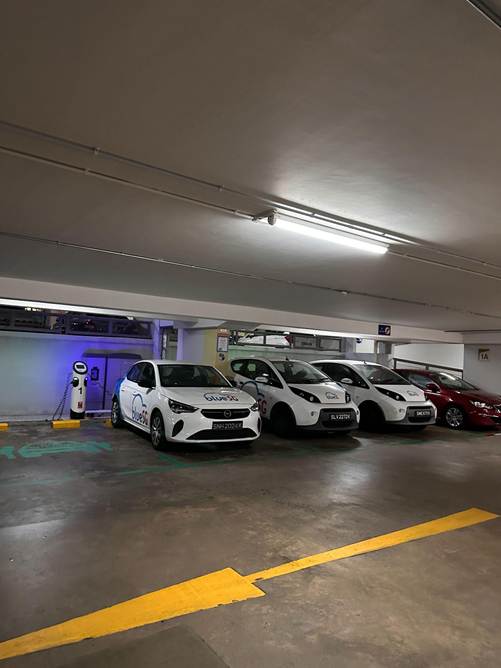
BlueSG is a free-floating, station-based service that runs on a pay-per-minute basis, and it was established in 2017 by Bolloré, a French transportation and logistics conglomerate that also had similar services running in Paris (Autolib’), London (BlueCity), Los Angeles (BlueLA) and Indianapolis (BlueIndy). For this paper in particular, I attempted to understand what car-sharing experiences were like for users. I interviewed 17 BlueSG users, after which I rode along with them for one car-sharing trip that was entirely determined by them in terms of purpose, duration and location.

The majority of my participants were Singaporean Chinese men in their 20s to 40s. Whilst their sexualities were not shared, many of them had direct references to ‘girlfriends’ and ‘wives’. For them, they saw a car as a means of performing one’s breadwinning sensibilities in heteronormative relationships, and there was a shared sense of unease that the shared car instead felt ‘plasticky’, ‘cheap’, ‘unromantic’ and so on. The pay-per-minute shared cars were not always in the best physical or aesthetic condition, as users – including some of those who participated in my study – would drive as quickly as they can to minimise their costs of using the service. Further, for a free-floating fleet, maintenance of the vehicles can be difficult to keep up with.

Many of the car-sharing users in my study also juxtaposed their experiences against ‘other men on the road’ who seemed to drive their own cars. Driving a shared car from a standardised fleet often felt out of place amidst the sea of privately owned cars, and this affective experience is further intensified in the context of Singapore, where car ownership is made costly through the Certificate of Entitlement and is therefore seen as a point of aspiration for many Singaporeans. Unsurprisingly, many of my research participants still retained the desire to own a car if they can eventually afford it in the future.

A line-up of BlueSG shared electric cars in a car park. Source: Author

So why does gender matter in car-sharing services? It matters because a shared car is not just a car, but it also invokes expectations amongst users which are often gendered in nature. Looking at the historical context of automobility, cars and private car ownership have frequently been tied to mobility, freedom and status for men of certain class, race and sexuality (Daggett, 2018). Automobility has also helmed significant aesthetic power in our urban environment through decades of marketing, engineering and consumption (Gartman, 2004), all of which produce particular car cultures that cannot be disentangled from existing gendered politics. While car cultures have certainly evolved over time and the socio-cultural meanings of a car have shifted for different groups of people, my research finds that there remains an underlying sense that a (shared) car still matters in the way people see themselves in relation to others. In the case of a car-sharing service that has a majority male user base, gendered expectations arising from the wider automobile landscape are often woven into one’s subjective experiences of car-sharing.

What are the implications of my research? It is important to reiterate that car-sharing services are still necessary in meeting the practical needs of people who need a car, and they serve a great purpose in cities that may not yet have strong public transportation systems or infrastructures for active mobility. However, if we are seeking to move away from private automobility, then we might need to ask if the car-sharing services that we have today are compelling enough alternatives to compete with the deeply embedded affective economies of automobility. This may require having nuanced understandings of what people expect in a car, not just in terms of its utility or functionality, but also in terms of its materiality, semiotic expression and socio-cultural meaning. Crucially, in thinking about the wider economies of car-sharing services, specifically the ways in which they operationalise on lean, platform-based business models, there may be a need to recalibrate the kinds of organisational structures that would be robust enough to provide a car-sharing experience that is as good as, if not better than, a privately owned car.

Yi Fan Liu, Transport Studies Unit, University of Oxford

2025 Hay Award Announcement

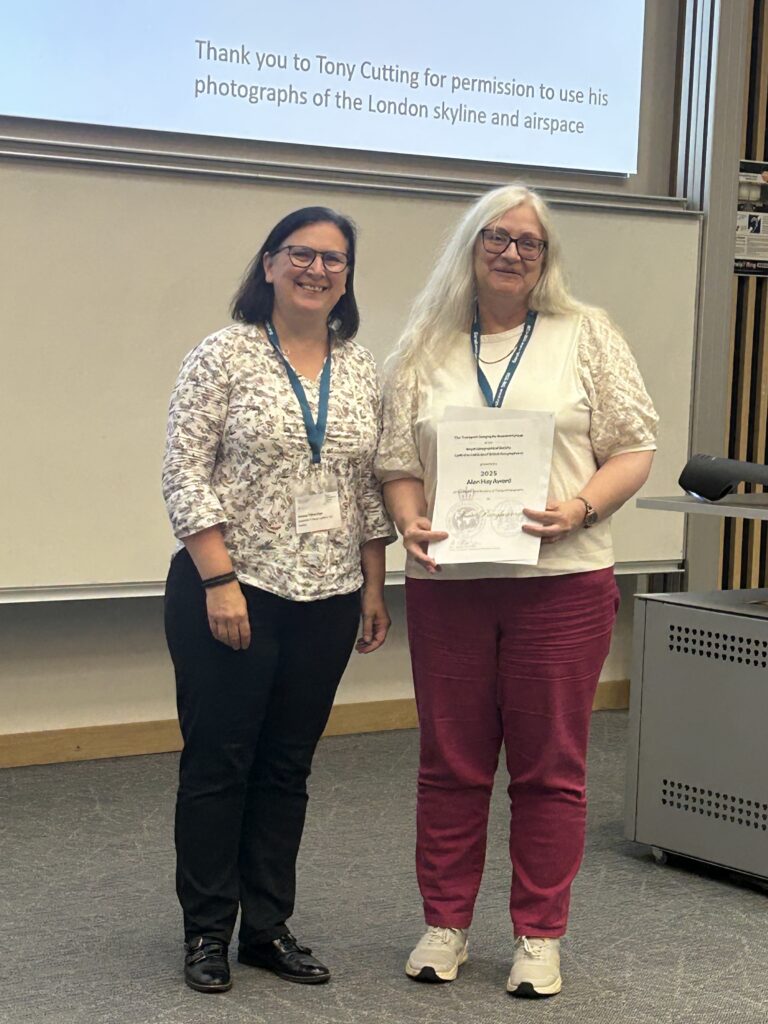
It is our great honour to announce this year’s recipient of the Hay Award: Professor Kate Pangbourne.

The Hay Award is presented annually to an individual who has made exceptional contributions to the advancement of transport geography in Europe. This may be through research, teaching, or service to the Transport Geography Research Group (TGRG). Following an open call for nominations earlier this year, the TGRG Committee carefully considered the quality, impact, and longevity of contributions before selecting the 2025 award recipient.

The Hay Award 2025 is awarded to Professor Kate Pangbourne in recognition of her sustained and distinguished contributions to transport geography.

Although she entered academia later in her professional life, in 2008, Professor Pangbourne has achieved an extraordinary breadth and depth of impact in a relatively short time. Within TGRG, she has served with distinction for over nine years, including as Chair from 2016 to 2019, guiding the group with vision and commitment. She has regularly convened TGRG-sponsored sessions at the RGS-IBG Annual International Conference, contributed as an associate editor of the Journal of Transport Geography, and delivered the prestigious Hoyle Lecture.

Beyond TGRG, Professor Pangbourne has championed transport geography through leadership roles as Director of Act Travelwise (2016–2022) and as an advisor to Transport Scotland. As Professor of Transport Transitions at the University of Leeds and Deputy Director of the Leeds Social Sciences Institute, she has been a driving force in advancing interdisciplinary research, forging connections between transport geography, computer science, and environmental science.

Through her academic leadership, professional service, and advocacy, Professor Pangbourne has profoundly strengthened the standing and reach of transport geography. The Hay Award recognises her outstanding commitment and her remarkable record of achievement in shaping the field and supporting its community.

In Memorium: Prof John H. Farrington (University of Aberdeen)

It is with great sadness that we announce the passing of Professor John Farrington, who died on 19th July 2025. John was a renowned researcher in Transport Geography with particular expertise in accessibility; digitalisation; environment, energy and sustainability; impacts of railways; rural transport; and transport privatisation and deregulation.

He was raised near Wigan, in northwest England, and graduated with an Honours Degree in Geography and a PhD in Geography from the University of Hull. His academic career at the University of Aberdeen spanned more than 40 years from Lecturer to Professor of Geography.

John was a founding member of the Institute of British Geographers’ (IBG) Transport Geography Working Group and Study Group (TGWG/TGSG) and convened its first research session at the IBG Conference in Aberdeen in 1972. He held various roles in TGSG, which later became the Transport Geography Research Group of the Royal Geographical Society (TGRG-RGS) in 1995. He was also a key member of the TGSG team that founded the Journal of Transport Geography (JTRG) in 1993, was its first Book Reviews Editor, and played a big role in JTRG becoming one of the top international transport research journals.

John’s research was recognised by two RGS Awards: the 2005 Brian Hoyle Lecture in Transport Geography which he presented on ‘Accessibility: a new narrative and critique’; and the Alan Hay Award in 2010 for his internationally significant contribution to Transport Geography.

In the later stages of his career and up until his retirement, John became deeply passionate about rural digitalisation. He led the EPSRC and RCUK-funded dot.rural digital economy research hub—at the time, the largest externally awarded grant in the University of Aberdeen’s history. The project created 60 new jobs and studentships, and produced groundbreaking research on how digital technologies could enhance the delivery of vital services and address key challenges faced by rural communities across the UK.

John was a genuinely avuncular man, remembered for his kindness and his unwavering willingness to make time for others. A natural mentor, he excelled at guiding younger staff and students, always leading by example with his patience, warmth, humility, and approachability. His legacy will be not only his research but also the values he instilled in others during his career. He is survived by his children Sinead and Conor and their children.